Disclaimer: I wrote this diary-esque ramble at irregular intervals throughout this last year, I have no idea why. Maybe I’m a text-based life-form?
September 12, 2022:
Back in Vancouver. It’s the final stretch of my doctorate, but thankfully this time Selin is with me. After her funding and Austrian visa were cancelled, she was unable to continue her lab work in Innsbruck, much to her dismay, and upon my invitation she left those lofty Alpine mountains for these loftless, Pacific mountains. She’s here for the year, working from home and writing her papers and looking for a job while I try to cobble together a serviceable dissertation from my disconnected chapter drafts. Let’s see how that goes. This should be good… Anyway, this semester I only plan on going up to the university twice a week, primarily for my TA duties, but also for the monthly seminars. Also, before we landed here this morning, we just spent three days in Iceland of all places, since it’s a popular layover destination. The landscape of this god-forsaken island called Iceland, but which should really be called Fireland in my opinion, is absolutely charnel. It’s an alien realm dangling on the edge of civilization, beaten into unnatural angles and rigid black contours by the intense winds and frenzied waves that continuously and persistently assault it. It’s completely devoid of any verdant color or of any plant taller than a few feet. The sun rarely shined – even in early September – and the dawn-mist seemed to forever linger and writhe and twist itself into eerie shapes.
The island broadcasts a mood somewhat reminiscent of the windswept emptiness of the Anatolian Plateau, particularly on a moonlit night. I remember this atmosphere from when my father drove us to Ankara along the main highway; the forested mountains of Bolu gradually peter out as the plateau slowly emerges in all its desolate, muted might. The interior of Iceland, meanwhile, is truly the stuff of nightmares: an infinite, dark backdrop of volcanic rock lined with iridescent geysers and steep, blackened ridges. The odd frost flower pokes its head above the desolate horizon and careens in distress at its surroundings, and it can be seen to scream when viewed in one’s peripheral vision, in the eye of a fata morgana. On a hill in the middle of Reykjavik an impressive church cleaves the sky with its somber, latticed rise. Its architecture supposedly represents the Icelandic landscape. Unfortunately, due to being a disconnected, weather-beaten island the whole place is exorbitantly expensive – thus we found ourselves mainly walking around and not really partaking in classy experiences or anything much. Also, of course, we did not even glimpse the aurora borealis, I’m beginning to think that whole fuss is just a giant hoax. Still, it was an amazing experience that evoked a scenic verve I hadn’t felt since getting hooked on Antarctic lore last year. Now that was truly a period of evocative imagination on my part, involving lots of dreaming and longing – despite the realization that I will likely never behold that white continent. There’s just something about these alien landscapes that are extremely alluring. I yearn to one day dissimilate and re-appear at the South Pole, observe the cutting-edge astronomical research, listen to the humming of generators running on ill-supplied jet fuel, assist with the hydroponic horticulture domes, communicate with the howling sub-zero winds that penetrate the thin membrane separating empiricism from insanity, and stare right into the void as the long darkness of the Antarctic winter subsumes all else. There is something both terrifying and terrific in beholding all that, and just maybe, the abyss may also gaze back.
Anyway, we’re finally here in Vancouver, the Asian colony on the Pacific coast of North America. I really don’t mean this in a xenophobic way, on the contrary, the rampant multiculturalism and particularly the blossoming East Asian scene is one of the main pluses of this otherwise dull and decadent city. I hope Selin enjoys it, I believe she will relish the Asian food-scene in particular, if nothing else. Now I really must focus on the seminar presentation Dimitris asked me to deliver on the 23rd of the month. I hate fiddling around with presentation software, especially since most of my GIS maps remain quite half-baked as of yet (or according to Selin, ‘unacceptably raw’). Well, so be it, I will be presenting a work-in-progress after all. But I still want it to be decent and somewhat captivating – one of the worst things in life is to be the cause of someone else’s boredom (and my subject matter is not the most exciting for most people). So, I don’t have much leeway here. The Medieval grindstone thus awaits… It’s very sunny though today, right this moment, surprisingly. Instead of returning to dusty manuscripts I instead feel like bursting out the front door of our overpriced basement dwelling and sprinting towards the sun. But then I remember the smoke. Forest fires have been ravaging the interior of British Columbia since August; a haze of smog still hovers in the air, although it has been dissipating a bit. In my opinion it’s barely perceptible but people seem to love making a massive deal out of it, complaining ad infinitum. Our landlord Kathy was actually wearing a face-mask this morning, while gardening, which seemed a bit excessive to me, but what do I know.
October 30, 2022
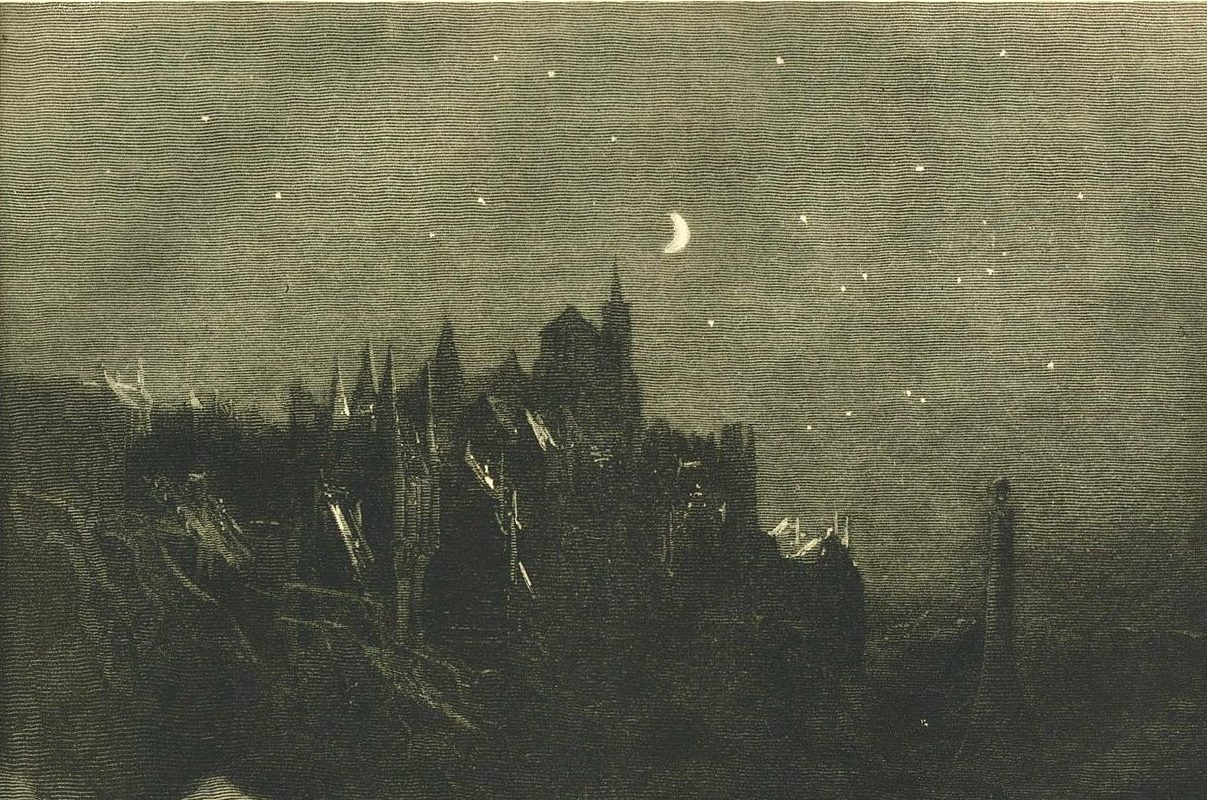
There are two types of people: those who have consumed a genre of literature first promulgated by Edgar Allan Poe in the 1830s, brought to cosmic maturity by Howard Phillips Lovecraft in the 1930s, and then bound to infernal darkness by Thomas Ligotti in the 1980s and the likes of Christopher Slatsky still today. Then there are those who have not yet encountered this spellbinding realm, luminous with dreams, despite the fact that “the only value of this world lies in its power – at certain times – to suggest another.” This realm is the domain of the short-story. I would like to discuss some of my favorite specimens within this hauntingly beautiful world. I’ll begin with Poe. The epitome of his genius is, I believe, most apparent in The Fall of the House of Usher. This is true perfection in horror literature, both in prose and content. While I do believe that some of Lovecraft and Ligotti’s stories surpass it, Poe was indeed the progenitor of this long line of cosmic horror weavers. He is the father of this realm. “… a mind from which darkness poured forth upon all objects of the moral and physical universe in one unceasing radiation of gloom.” Poe’s description of Usher, illustrated here in this small germ from the story, revealed a new avenue – new for its time – for how horror and existential dread could be kneaded into literature and thence into its readers’ minds. Another of Poe’s stories features the line, “those who dream by day are cognizant of many things which escape those who dream only by night.” This very line of thought, for instance, can be traced all the way to both Lovecraft and Ligotti, and many other acolytes. Poe’s poetry is also something else. And although his most famous is The Raven, my favorite will forever be The Conqueror Worm. And how can one ever forget the exquisite, almost poetic prose in Eleonora, or the conceptual novelty of stories such as The Pit and the Pendulum, The Masque of the Red Death, or Descent into the Maelstrom. And what of The Man of the Crowd? A concept that is so simple, yet simultaneously maddeningly suggestive and complex. Poe was a true genius. Unlike his later successors, who took similar concepts to maturity and beyond, Poe was the first. He was the promulgator, the Avatar. His stories are therefore less existential and less horrific in comparison to his continuators but were ultimately more novel in their time.
A century after Poe mysteriously perished at the age of 40, the reclusive hermit known as Howard Lovecraft was gripped by the former’s outlook on both horror literature and our position in the cosmos. Lovecraft did more than anyone else to take this and work it into a fully-fledged literary genre, known today as “cosmic horror.” Now, I do believe it is best to immerse oneself fully in Poe’s oeuvre before delving into Lovecraft’s, for the latter builds upon the former in the most exquisite manner possible. Lovecraft was a man of letters with his mind embedded in the seventeenth century, in the slanted roofs of small cottage hovels in whose attics faceless entities morph sinisterly into existence on occasion when one’s peripheral vision brushes upon them. Lovecraft’s essay on Supernatural Horror in Literature is an excellent piece of non-fiction, and his extensive letter collection – that he wrote at great length in the 1920s and 30s – are beyond fascinating. Some of these letters have recently been compiled into two large volumes and are among my favorite reads, despite Lovecraft never intending for them to be read by the public, let alone published. I definitely share Lovecraft’s love of dusty, ancient manuscripts, behind whose pages lurks the ever-present possibility of encountering some twisted, long-lost lore from many epochs ago when legless lifeforms crawled on earth’s scarce-cooled crust. As to his fiction, his tales; my absolute favorites would have to be: The Tomb, Rats in the Walls, The Dunwich Horror and The Shadow over Innsmouth. The Tomb packs about as much suggestive horror in a small text-space of its size as the laws of physics allow. For Rats in the Walls, both the premise and how expertly the final, gnarly revelation is unveiled makes it a true masterpiece of horror prose. The Dunwich Horror is a bit wordy in its first few acts and I was initially inclined to rate it lower, but when the manuscript-focused saga begins around the halfway mark I was immediately hooked and quickly realized its mastery. And then the ending – that last act – with the panoramic stuff, weather-phenomena and sheer terror is so incredibly well written. As for Innsmouth, well, this is probably my favourite of Lovecraft’s works. The narrative is one of the best crafted and most captivating of Lovecraft’s productions; a lot of themes that he left in infancy in his earlier works come to full fruition here. It is no surprise that Ligotti and others have borrowed heavily from this theme. Beyond these fantastic four, honourable mention goes to the Call of Cthulhu, its introduction is so iconic and remains completely unmatched, outclassing all other first paragraphs in horror fiction, in my opinion. I mean has such an iconic first paragraph ever been written:
“The most merciful thing in the world, I think, is the inability of the human mind to correlate all its contents. We live on a placid island of ignorance in the midst of black seas of infinity, and it was not meant that we should voyage far. The sciences, each straining in its own direction, have hitherto harmed us little; but some day the piecing together of dissociated knowledge will open up such terrifying vistas of reality, and of our frightful position therein, that we shall either go mad from the revelation or flee from the deadly light into the peace and safety of a new dark age.”
This entry here, this single paragraph, summarizes Lovecraft’s cosmic existentialism in a nutshell. This is a theme that he binds to the eldritch horrors that pulsate in the dark gaps between the stars and quiver in the unplumbed ocean depths. Perhaps more sinisterly though, it is the eldritch horror that Lovecraft inserts into the everyday, most mundane life that is truly horrifying; barely perceptible optical phenomena, barely audible whispers carried by the wind, a barely observable glint of madness lurking behind the moist pupils of a loved one, etc. Returning to Cthulhu, despite its iconic entry and its enjoyable investigative build-up, I do think the mid-sections drag a bit, and the ending in particular is a massive let-down. It is strange how what would become known by lay-people as Lovecraft’s most iconic story has arguably one of the sloppiest endings; it does not do justice to the amazing build up that we are treated to. I also enjoyed The Festival, The Lurking Fear, The Shunned House, Dagon, The Colour Out of Space and At the Mountains of Madness. The geologic/architectural parts in At the Mountains are like Nameless City on steroids. The Antarctic setting and the concept of encountering a long-lost civilization there is also captivating, especially considering my predilection for the area. It evokes the old, abandoned South Pole stationed narrated in the memoires of John Byrd; what sub-zero horrors skulk in its dark, snow-padded and scarcely-accessible corridors? Alas, despite its enticing suggestive prowess, At the Mountains is a bit too long; it drags on way too much and features lots of wordy, adverb-riddled repetition.
Half-a-century after Lovecraft perished in relative obscurity, and just as his mythos had begun gaining popular appeal, a nihilist and gloom-weaver named Thomas Ligotti took up the mantle and plunged head-first into the void. The stories that Ligotti published in Songs of a Dead Dreamer and Grimscribe in the 1980s opened up whole new vistas of subtle horror, that is horror of the mind and of the everyday. After reading Lovecraft I did not think it possible for a new sub-genre, a new horizon, to be woven so gracefully out of the exquisite beauty of cosmic horror. Yet Ligotti proved me wrong. The darkness he inserted into this realm is beyond description; he reminds me of Usher from Poe’s story. For instance, Dr. Locrian’s Asylum is incredible, as is The Music of the Moon. I have no words for how Ligotti even came up with these, they are the outputs of true genius. Another of my favorites is The Last Feast of the Harlequin, it would have captivated Lovecraft. It’s a bit like the latter’s Innsmouth, but on steroids. The “festival masking a darker festival” concept is so well formulated here. Accentuating the whole experience is the fact that each sentence in a Ligotti story is clearly so well thought-out and positioned with such care that it becomes an eloquent pleasure to read. Another one of my absolute favorites, The Shadow at the Bottom of the World, showcases Ligotti’s brilliant prose in full glory, and the story truly is the produce of an “abyss in the outline of a man.” How can a tale be both so dark yet so radiant, how can it haunt the mind yet also coax out such luminosity? It’s truly incredible. Other great stories in Ligotti’s oeuvre are, in my opinion, Aunt Elise’s Christmas Eves, The Sect of the Idiot, and Dream of a Manikin.
One of the beauties of the short story genre is the perfection with which each sentence must be constructed to deliver maximum impact in condensed format. Of course, the horror genre is no stranger to this. Take, for instance, the sentence: “If you see it, it sees you.” Such an elementary phrase, yet when delivered in the right setting with the proper consonantal emphasis it can pry open the most primal of suppressed thoughts. But the masters of short horror take this a step further, delivering the hardest hitting of conclusions sometimes with but a single word, leaving the reader stunned and subsumed. For instance, take Ligotti’s The Chymist, which ends: “Now Rose of Madness – BLOOM!” That final upper-case imperative verb ends the tale on such a crescendo of horror, such a terrifying, visceral suggestion that a more horrifying finale can scarcely be possible. I feel like Ligotti approaches the Dionysian dialectic that Nietzsche identified in Greek Tragedy. After all, if anyone has peered into the human abyss better than Sophocles it’s probably Ligotti. I have been informed that one of the best modern continuators of this legacy is Christopher Slatsky and I am eager to purchase his The Immeasurable Corpse of Nature. It would be impossible for me to finish this excursion without adding this quote from Ligotti’s Songs: “Life is a nightmare that leaves its mark upon you in order to prove that it is, in fact, real. And to suffer a solitary madness seems the joy of paradise when compared to the extraordinary condition in which one’s own madness merely emulates that of the world.” Alas, here is my current tier-list, as it stands, of these three paragons of horror short stories. S-Tier is perfection, A-Tier is great, B-Tier is respectable, C-Tier means it did not resonate very much with me:
E.A. Poe: The Fall of the House of Usher (S Tier), The Conqueror Worm (S Tier), The Man of the Crowd (A Tier), Eleonora (A Tier), The Pit and the Pendulum (A Tier), The Cask of Amontillado (A Tier), Descent into the Maelstrom (A Tier), The Raven (A Tier), Manuscript found in a Bottle (B Tier), Murders on the Rue Morgue (B Tier), Masque of the Red Death (B Tier), The Black Cat (B Tier), The Gold-Bug (C Tier), The Purloined Letter (C Tier), Ligeia (C Tier), William Wilson (C Tier).
H.P. Lovecraft: The Shadow over Innsmouth (S Tier), The Dunwich Horror (S Tier), Rats in the Walls (S Tier), The Tomb (S Tier), The Colour Out of Space (A Tier), The Lurking Fear (A Tier), The Shunned House (A Tier), Nemesis (A Tier), Dagon (A Tier), The Call of Cthulhu (A Tier), The Festival (A Tier), At the Mountains of Madness (B Tier), The Hound (B Tier), The Thing on the Doorstep (B Tier), The Nameless City (B Tier), The Haunter of the Dark (B Tier), Herbert West: Re-animator (B Tier), The Horror at Red Hook (B Tier), Pickman’s Model (C Tier), The Cats of Ulthar (C Tier), The Whisperer in Darkness (C Tier), He (C Tier), In the Vault (C Tier), Under the Pyramids (C Tier), From Beyond (C Tier), The White Ship (C Tier).
T. Ligotti: The Shadow at the Bottom of the World (S Tier), The Music of the Moon (S Tier), The Last Feast of the Harlequin (S Tier), Dr. Locrian’s Asylum (S Tier), Aunt Elise’s Christmas Eves (S Tier), Dream of a Manikin (A Tier), The Sect of the Idiot (A Tier), The Dreaming in Nortown (A Tier), The Greater Festival of Masks (A Tier), The Nyctalops Trilogy (A Tier), Nethescurial (B Tier), The Frolic (B Tier), The Mystics of Muelenburg (B Tier), In the Shadow of Another World (B tier), Vastarien (B Tier), The Lost Art of Twilight (B Tier), The Flowers of the Abyss (B Tier), The Spectacles in the Drawer (C Tier), Les Fleurs (C Tier), The Cocoon (C Tier), The Library of Byzantium (C Tier).
Rather fittingly, since last week I’ve become quite active on various cosmic horror subreddits, sharing my comments on some of these timeless masterpieces that pierce the warp of time. And on the bus back and forth to the university I’ve been composing some of my own eldritch tales, such as “the demon of Kastamon” which adds a somewhat comedic twist to a geological expedition gone awry. I also purchased a Miskatonic University t-shirt from the official HPL merch store, likely causing Howard to groan in his grave. Alas, cringe or not, until the great Cthulhu crawls out of his century-long entrapment within that weathered manuscript in the library of Brown University, I feel safe from his ire. Either that, or he lurks beneath the sea, in both cases I eagerly await our dream communications.
Anyway, enough with this gabble, after my successful seminar presentation last month, I must now return to full-on grind mode – and thankfully the weather has been getting exceedingly gray and rainy, forcing me indoors. I’ve become quite an expert at scouring Byzantine manuscripts to extract information on Paphlagonia and all things relating to provincial Asia Minor. My inquiring gaze eviscerates the cataleptic pages of various obscure Vitae and Miraculae, left defenseless after centuries of neglect, causing them to slowly bleed information which I can then suffocate between the pages of a doctoral dissertation. Compressed between pages heavy with data and analysis, these little historical flowers are unable to bloom again. Yes… I really need to aerate my pages a bit. I need to pick up my dissertation and shake it to dislodge all the bloat that vomits at the reader. Moreover, I must let the sources speak for themselves. The flowers must effloresce, they need to bloom, one more time. I owe it to them.
November 15, 2022:
The weather is absolutely god-awful these days. After the fortnight of brilliant sunshine that we were treated to in the second half of September, October and November have been a complete curtain drop. Gray, moist walls of doom and gloom hover above us at any and every given moment, threatening to invert themselves and drench us at the most inopportune times. I took a shower yesterday to excise the ichor that clings to me like a warbling blanket. The shower curtains protested against my presence, as usual, lurching towards me and sticking to my legs as if toying with a cadaver. The annoyance of this mild tussle increases with each repetition. The fan does not function properly either, so the entire room steamed up and began bleeding moisture from its yellow-tinged walls, as usual. Disembarking, I gazed directly into the mirror: a morose calamity leered back at me through the squalid vapors that still effervesced around the room. The thing in the mirror began moving (squirming?), trying to adjust its ghastly contours to something mimicking pleasantry. Was that meant to be a smile? With each “attempt” the creature in the mirror only further solidified into that rigid aberration that it sought to conceal; a petrification broadcasting complete emptiness, an abyssal nadir hiding in the non-space of a reflection. The mirror was crying. Tiny beads of condensation hurriedly drew imperfect lines as they sought to escape the grotesque malformation that haunted their home. Everything was wet and dripping. I stopped gazing at the thing in the mirror and reached for my moist towel, but I know it still lingers somewhere within that murky glass surface, somewhere beyond it.
Today I wish to record some observations that I made over the past six years, during which time I’ve been employed as a Teaching Assistant in both Turkey and Canada. The biggest cultural difference to me has been people’s mindset. Here in North America it’s wide open. It’s difficult to really explain this so I’ll give an example. Last year as we were covering the Cold War and Canada’s position therein, one second-year university student asked me: “Is Communism bad?” I was taken aback by the simplicity and naivety and just everything about this inquiry that pinned me in my place as twenty eyes curiously awaited what the hell I’d say. This was my class; I was the authority, I needed to respond. Of course, communism is not bad, in fact, it’s the most misunderstood ideology in the world – I wanted to say. But instead, I said something much vaguer and completely open to interpretation and sort of moved-on immediately. Anyway, that’s not the point. The point is that a student would never ask something so naïve in Turkey, and this level of political innocence simply would not even exist at university level. This question is only marginally better than the likes of “are women bourgeois?” and other types of political humor formulated by Robert Kurvitz. But this question was an actual inquiry – in a university.
In North America I have found that each undergraduate student is more of a tabula rasa waiting to be filled in, not just by me, but by their whole learning experience. Initially I felt discussions were dumbed down to a ridiculous level with any sort of political or historical subtlety and finesse thrown out the window. Students vomit elementary inquiries left and right, broadcasting both ignorance but also, ironically, curiosity. In the classroom we seemed to be building everything from the ground up; to discuss communism, we first had to define it, since no one knew anything, giving me all sorts of wiggle room to disembowel the students’ worldviews. But, over time, I’ve come to appreciate this attitude, for there is less ingrained grime that needs to be cleaned. There is still of course systemic grime, but that’s a different story. The cephaloid tendrils of that sort of grime suction onto one’s mind through the diffuse power of the everyday. Me and my students here have discussed all sorts of issues which would be too politically charged and heavy to discuss in Turkey. But being able to have such open discussions is actually refreshing. The classroom can breathe. We can populate these yawning abysses with fresh blood, with the roiling plasma of original thought, however juvenile or premature it may be.
Discussing the details of Canada’s recently admitted genocide, for instance, at first felt daunting to me. I’m not even Canadian, after all. Who am I to start acting as a fulcrum of discussion for a topic that I thought would be highly tense. But no, it was not tense or sensitive in the manner I expected. Of course, the issue is somewhat sensitive, but not in an aggressive sense. Different opinions echoed in the room, divergent outlooks clashed, different background collided and debated – but all of this went quite smoothly. It was not charged to oblivion and back like a similar event in a class in Turkey would be, if a brave and idiotic soul ever attempted to undertake it. Basic issues from democracy and its inadequacies to conscription and dying in war, and from unionism and its pros and cons to Robespierre, Marx and Bakunin – stuff that is automatically inundated with hard-line opinions in Turkey – are open discussion here. This has been nice. On the other hand, I do sometimes miss the polish and suavity of Boğaziçi students. Many things I suggest or imply seem to fly over idle-eyes here. I suppose ignorance is a luxury. After all, in a country like Canada there is no real reason to be versed in such “boring” stuff before it greets you in a classroom. Another large difference is the racial plurality here, which opens a whole new horizon. This may be one reason why historical-political polish seems less, simply because it’s been diluted across a much larger background pool. In Turkey, while we have Kurds and Turks and whatnot, everyone generally operates across the same somewhat myopic milieu. There are not many international students at Boğaziçi, nor those from a substantially different culture, thus basic historical memories are more rigid and intractable. And monolithic historical memories – or the lack thereof – are powerful vectors of guidance on how one can operate in a classroom, it would seem.
November 25, 2022:
6:25: Awakened by the boiler vacuuming the silence out of the night. Must get up soon anyway, assistantship duties await. Gaze at the ceiling as a fissure of gloom opens and closes; valuable minutes are gladly wasted. I eventually creep out the room quietly, lest I disturb the cocooned angel hiding among the blankets. It’s dark outside, so very dark. Coffee is a necessity at this hour, preferably as dark as the night.
7:30: Front door creaks open and I head out, backpack still damp from yesterday’s downpour. It’s frigid outside and barely any lighter now. A gray blanket suffocates all memory of the sun. Shards of glass crunch under my boot as I turn onto Commercial Drive, wiping rainwater off my nose and forehead every few seconds, otherwise it tickles. A few fentanyl addicts lie curled up in the foetal position beneath porous tarps that line the pavement, barely alive, trapped in the liminal space between life and death, squashed between societal indifference and disgust. Life is harsh, I generate thoughts. Guilt, sorrow and gloom stick to my mood as the bus is delayed, as usual.
7:55: Finally on the bus, on that grubby meat-shuttle that crawls along Main Street at a snail’s pace. A quick glance around reveals a standard sight: A handful of neatly dressed Asian students sit near the front, while some whites line the rear with their colorful baseball caps saluting beneath over-sized hoodies. Stereotypes are alive and pumping. I sit near the Asians, usually cleaner, quieter, and more respectful: lower chance of drama. Music dissipates the morning ichor, very slightly. An eventless ride.
8:50: Have 5 minutes to grab an overpriced, under-deserved coffee before running to the lecture hall in the Academic Quadrangle, that maze like grotesquerie resembling a nuclear silo. My choices leave a lot to be desired. But this is North America: begrudgingly approach Starbucks. Forced Canadian politeness incinerates my insides as I stumble through an unnecessarily long conversation at the till, the growing queue behind me already spilling out onto the rain-battered street. I must seem so miserable. I laugh in European.
9:04: Late to class again… and as the assistant too, how embarrassing – but is it really? Thoughts distract me from the silhouette of a professor miming a lesson at the scattered remnants of those who made it to the lecture on that god-forsaken winter’s morning. I’ve heard it all before anyway; it’s not my first HIST101 rodeo. I wonder how many students are really listening; I can see several of mine browsing the internet on their laptops, feigning note taking.
10:50: Class dismissed, at last. I hover around the professor as the students file out; being sufficiently visible is my duty. As ten folds into eleven I gaze at my ‘lesson plan’ for the afternoon, soon I will receive three sections of students, one after the other, with no break in-between. The first session will serve as a testing ground for a variety of terrible jokes and punch-lines that line the intellectual void. Should they land well, they will enter my subsequent tutorials disguised as newborns. I dread the first one, always an unknown. Plus, I feel underprepared today.
14:00: The afternoon commences. Lesson merges into lesson as students come and go like the draught that blasts through the AQ building. The hat-trick of pedagogic delivery tires my mind enough to free me from the bleakness outside. I’m momentarily liberated from reality as the eagerness of some students amazes me. Am I actually having fun?
16:50: The final set of students evaporate out the door and blend into the non-space of the corridor, yellowed by time and perspiration. I can go home now. God, that’s a hassle though… Rain continues to pour forth from the stratosphere. It’s almost entirely dark now, not that it was ever properly light. I smile at the absurdity. Why are exoplanets enslaved by bright orbs that cannot even penetrate the thinnest layer of vapor? Gravity sucks, I think in American.
17:10: The bus is too crowded to get on, I tire easily. Time to give up. I head to the library. It smells of paper and old books. I decide to spend some time here, so that the herd thins out a bit, idly browsing my phone, unable to work on anything meaningful. I feel sleepy. I am soberly reminded that if libraries did not already exist here, they would probably be considered socialist ideology.
19:15: It’s now the lost hours of the evening, and I’m finally back on Commercial Drive. A sleet like haze of mini-icicles sully the sky, oriented downwards. The opioid-slaves are awake, apparently not dead yet, their vacant eyes portals to luminous dreamworlds receding beyond the decadence of modern society. I wonder if it’s warm in there, for it’s damn cold out here. My shoulders ache from pulling them towards my ears; the perfect seeds of a tension headache, likely to bloom into a full-on head-cracker. Yelling and scuffling noises are audible in the backstreets as I slither back home.
19:35: I notice Selin perched at the large desk in the sitting room, since she’s left the blinds open and it’s completely dark outside. The light of stars is in her eyes, and in her raiment glimmering, her thoughts dancing to the music of a pipe unseen. The corners of my mouth rise up in an arc. I ring the doorbell just for the sake of it, watching as she jumps up. Her hair reflects rays of starlight like a forest of silver. We embrace at the door, like the long-lost electrodes of an arclight. The warm indoor air collides with its outdoor counterpart, an atmospheric embrace mimicking the flesh. I enter the light.
November 30, 2022:
Sometimes I contemplate whether diverging from Physics, from the core of all sciences, was really the right choice for my temperament. For gazing out at the night sky, it is simply impossible to suppress one’s childlike, almost juvenile curiosity at the great unknown gulfs pulsating away there. What I mean by this I think was best captured by Carl Sagan when he said, “somewhere, something incredible is waiting to be known”. One of my earliest memories of pure, unfettered fascination was probably during prep year at Robert College when I discovered a hefty tome on NASA’s SETI programs of the 1970s and 80s. It was tucked away in some dusty shelf that no one ever visited; a bespeckled spine begging me to reach for it. I read the whole thing over the course of a few days. This was around the same time that me and Sinan found an absurd caricature book of a man slicing up his penis and feeding it to a bartender among other wild depictions. We laughed so much – in the library – that the turtle-faced librarian, Mr. Whoeverthefuck, that Emre always claimed was a CIA agent, turned up and ‘confiscated’ the book from us. Rather interestingly, several weeks later we glimpsed the book still sitting on his office desk rather centrally. Theories about this incident occupied many fervent episodes of laughter.
Returning to the matter at hand, the point is that there will forever remain something, somewhere waiting to be known, like Sagan said. We better hope that too, for if all is known what is the purpose of continuing to live? That would be akin to following a pre-planned trajectory of absolute certainty, an insufferable thought. But there will always be something granting us the mercy of mayhem and perplexity. For instance, while we may know that Jupiter’s L4 and L5 Lagrangian points create ‘gravitational wells’ where objects enter otherwise impossible orbital stability, and while we know that this helps shelter Earth from destructive asteroids, and while we may attempt to comprehend what would happen if Jupiter instantaneously disappeared, it is all essentially mathematics. We will never truly understand the full scope of things due to the evocative limitations on the scale of our little human minds. We are able to comprehend what a centimeter, meter, or kilometer in distance means, for these are familiar entities that our primordial fabric is accustomed to, and it is perhaps possible to fathom a few thousand kilometers (as in a trip around the globe), and even the distance between the earth and the sun (roughly 150 million km) can perhaps be vaguely situated in some near-abstract corner of our terrestrial brains if we really push our evocative wits – yet, what about a light-year? We know exactly what that is numerically, but do we really get it. You can’t really close your eyes and ‘imagine’ or truly comprehend something so beyond us, our molecular fabric just won’t bend that way.
For instance, consider the Hercules-Corona Borealis Great Wall: A galaxy filament about 10 billion light years in length, making it one of greatest known structures in the observable universe. Or consider the Giant Void, an eerily barren region of space about 1.3 billion light years across. Trying to ‘think’ about these sorts of entities gives us humans an overflow error of some sorts, we are simply not programmed to be able to think of such colossal things in spatial terms, they instead remain abstract in our minds. Perhaps even more mind-boggling and psyche-dismantling is the very size of our universe. According to latest scientific understandings, the negative gravity of a supercooled Higgs field propelled such as a gargantuan wave of inflation in the first moments of the universe that today its total size must be orders of magnitude greater than what we can observe. In other words, our observable universe (constrained by the speed of light times the age of the universe) is so much smaller than what’s really out there. What sort of stuff is lurking out there that we can never know of? It’s maddening, exhilarating and ego dismantling all at once. Pale blue dot indeed.
Anyway, since there is always a ’next step’ and a new unknown in scientific inquiry, there will never be a moment when we can conclude, “okay, that is the end, it’s all solved.” And there is also the possibility that perhaps we have everything wrong. There is beauty and the excitement of endless discovery in this thought alone. It is currently impossible to disprove the simulation theory, for instance. But this also implies that perhaps it is more relevant to concentrate on the human psyche to understand what we can. This is where, I believe, the primordial essence of what we call consciousness, or that illimitable void which binds us together as a bunch of self-aware cellular reactors, would benefit from being placed under the microscope. Fields in the humanities, lately disregarded as vestiges of a superfluous aristocracy, are essential in this quest. The idea of human fear and how its conscious or unconscious manipulation leads to a sense of elation, for instance, is an undervalued avenue of inquiry. Perhaps the endless quest of ever slicing a fractal into infinitely and indefinitely smaller sections of ‘knowledge’ is not relevant? Maybe the minute details of the metric tensor over which our pseudo-Riemannian manifold operates is not as relevant as we think? Or maybe the enigma of why gauge fields interact differently with mirror fermions is not quite so maddening. Who knows… Plumbing the human psyche and our ancestral world may reveal more of what we are and where we came from.
This long-winded and poorly delineated explanation is, I think, how I reconcile the fact that I switched fields. I know it’s a bit of a stretch, but this is a diary entry after all, you surely did not expect coherence on the level of an academic article. But I can provide a more tangible defense of the social sciences: Mankind is able to split the atom and fly to Mars, yet has made close to zero progress in social metrics such as how to best govern a group of people, or what a penal system should involve etc. etc. While the former are things our brethren living several millennia ago – such as in Ancient Greece – definitely couldn’t do or even fathom, on the latter qualities we are basically still at the same point that they were at thousands of years ago! The current state of humanity is effectively a large glob of socially inept dimwits surrounded by marvellous technology. We are much better at inventing and discovering things than we are at thinking about said things, sorting through them and re-orienting ourselves accordingly.
I think all this, but on second thoughts perhaps this is all mental gymnastics that my tormented mind is unpacking after having transitioned from a Physics degree, where I learnt how to calculate the empiric mysteries of the cosmos, to a Medieval History degree, where I am currently probing into the minds of people that are dusty relics of long-lost aeons and painting pretty vistas of their warped ideals and distant, faded worlds. In this line of thinking nothing matters, of course. Yet I need a ‘profession’ to continue certain basic necessities of life that my weak mind has become accustomed to, and academic inquiry – particularly that of researching aeons past – remains the most alluring conduit towards basic financial renumeration. It is of course a difficult one in this decadent age where every clod on the street is an ‘expert’ in something, and there are over 7 billion of these clods roaming the streets and howling at the moon. When else in human history has scarcity in any particular skill been at such a low point? When else has the numerical tide of mankind swollen to such gargantuan proportions to eclipse any form of individual meaning? I hear that the global population will begin declining soon, they say around 2050 or so, meaning I have indeed lived in the apex of modular insignificance.
December 9, 2022:
The long Canadian winter has begun to engulf not only our enfeebled bodies but also our minds. Outside, the sky bleeds somnolence, never properly illuminating the lackadaisical husks that wander about the streets, permanently damp and cold. My skin seems to be shriveling, my hands are so dry that each time I bend my knuckles new rivulets of blood form in the cracks and crevices. Each time I exit the shower I feel my skin stretched taught like a drumskin; it hurts to move. Every so often I catch the malformed mirror-entity still grinning at me through a smoke-screen of moisture and glass. It’s also always so dark and drab, and caffeine can only kindle one’s life-energy so much. We’ve been perusing coffee roastery after roastery, spending days and days just sitting and writing, our tenancy excused over a single coffee per day (since it’s not cheap). Still, being together with Selin, we have somehow managed to cultivate a modicum of coziness inside our wailing basement abode. We hung up some Christmas lights the other night, and at least our couch-TV setup is not too uncomfortable, but the main generator of warmth is conversation and interaction – things I sorely lacked in my previous years. The spectral winter thus cannot harm us, we immunize each other.
Out of absolute boredom, I have been getting excited about a possible cryptographic puzzle game that I wish to devise for my friends, something which resurfaced after my recent obsession with the Voynich Manuscript. Things such as the undeciphered Voynich Manuscript or the recently discovered subterranean semi-ape humanoid species called Naledi are indeed very curious in their revelations, or in the former case, limitations. I dream that the Naledi are inhabitants of Agartha, the ancient subterranean kingdom professed by the French occultists, Gérard Encausse and Alexandre d’Alveydre, and linked to Tibetan asuras by Helena Blavatsky. Of course, it remains a puerile phantasy at this point, yet an ever-alluring one. The Voynich, meanwhile, is even more maddening since it’s not a product of the mind but an actual physical object. Centuries of deciphering attempts by experts including mathematicians, cryptographers and linguists have thus far been fruitless. Despite all our advancements in cryptography and artificial intelligence we are still unable to crack the surface of this insidious tome. I’m sure it’s not a hoax, it has an ethereal quality. What eldritch mysteries lay cloaked behind its pages? What sort of grim infinities lurk inside its undeciphered characters, curves and sigmoids? What primordial message are we missing out on here? The Voynich remains fascinating, especially given my predilection for both mystery and old manuscripts.
Speaking of, if I ever have an actual physical space to call home on a long-term basis, alongside a modicum of money, I would like to create a cozy office-den lined with manuscripts of historical nature, alongside horror tomes, haunted folk tales, and perhaps also biographical and epistolary works, because I enjoy them, a guilty pleasure if you will. Sadly, this goal remains ever-elusive, since I’ve not had a long-term abode in so long… Yet I may dream on as I claw at the charred gates of academia and its ephemeral job-market. What I picture is a dark space that both relaxes the senses but also invigorates a sense of brooding and reflexivity, perhaps lined with heavy Victorian or Gothic furniture and gadgets, alongside a small yet high quality sprinkling of eldritch paraphernalia, just to slightly unbuckle one’s third eye. In my mind, this office has deep-set, suffocating curtains that are only opened at night to let in the moonlight, these curtains could be black or deep scarlet, which would complement the heavy wood furniture. The lighting should be dreary and somber and focused on the desk, which is the center-piece of the room, so as to keep the background in a slightly unsettling hue and not lull the mind too much. A wavelength closer to the warmer yellow is of course preferrable over the horrid, maddening florescent white color that is a disservice to one’s sanity. Oil lamps would be nice but probably not practical enough to consider.
Along the walls I envision framed images of the engravings of the likes of Gustave Dore. Particularly his illustrations of the Rime of the Ancient Mariner and Dante’s Inferno come to my mind. What an evocative artist, there is such a haunting beauty in his works, it is possible to gaze at them for ages since their suggestive power never falters. If I can’t find a decent physical edition of Dore or other eighteenth century French engravers, then the atmospheric seascapes of the likes of Turner (Fishermen at Sea) or Reinagle (Floundering in a Gale) may suffice. Another option would be an evocative night-scene such as Fireworks for the Birth of the Duke of Normandy, by Pierre Antoine Demachy (ca. 1782). I love dark-gloomy art with an atmospheric obsession, and I think this sort of thing would look sublime in a creative space. But the details of what to line the walls with is naturally subject to change depending on the shape and orientation of the room. Of course, tying my spiritual exultation to such materialistic trifles is embarrassing when I consider it for a minute, however this sort of a small, private space remains a sort of guilty-pleasure for my worldly cravings. I have such a weak spot for old-school studio setups, no idea if it developed over time due to my love of libraries as a concept, or because of the gnawing frustration of never having a constant abode to pay any attention to, or perhaps it’s my grandfather’s office that I subconsciously envy. Either way, whenever I see someone else’s studio area, or home desk or anything of that sort, I always feel like I’m seeing something deeply important and love investigating it in menacing detail, half out of fascination and half out of reflexive considerations.
Returning to cryptography, ever since I became interested in the Voynich manuscript I have been researching ciphers out of curiosity. The Vigenère Cipher seems a good enough way to encode plain text for amateur purposes. The simple substitution cipher or the rail-cipher seems a bit too easy to decode. The Enigma Machine and other complex variants of pre-Victorian ciphers seem unnecessarily complicated for amateur usage but could be fun to meddle with later. I plan on incorporating all this into a puzzle game I wish to design for my friends. If I go the Vigenère route, I think it would best to slip the cipher key in plain text somewhere else (maybe in the initial description) in a sort of subtle-but-not-too-subtle format. That way the RP element would not be crushed too much by the meta-game – which requires a delicate balance, something that I’ve been analyzing in the Exit Game series by Kosmos. I am, of course, not bound by the knowledge requirements of such commercial products and will therefore assume a certain level of competence in complex mathematics, cryptography, and criminology, alongside knowledge in various geographical, historical, and literary markers – in other words, open internet puzzles. While one may dream of replicating the enigma levels of things such as the Cicada 3301 (whose third iteration still remains unsolved) whose cultic vibes even Crowley and Blavatsky would have marvelled at, it is not my goal to create such complex things. The aim is to have fun within the timeframe of either a single 2-3 hour sitting, or over multiple such sittings spread over a several days (much like a DnD campaign may be played). It should be difficult yet satisfying to solve, I hope. An ideal puzzle should keep its beholders in a constant flow-state where it never gets too overwhelming or maddening so as to break immersion or risk them giving up. I will need to see if my idea of making my cipher key part of an URL extension is too complex. I am also considering using playing-cards which will just so happen to be inconspicuously arranged in some not-too-difficult mathematical series (e.g., Fibonacci sequence with the Black cards, while the Reds act as fillers), and the ‘next card’ in the sequence will somehow function as a numerical key for something. Let’s see how things pan out – I also need a plausible narrative of course. It has indeed been a while since I created a puzzle-adventure, something I really enjoyed the last two times I did it.
Anyway, beyond all that gabble, I have just finished two brief forays into Asian horror-adventure. First, I played Rewinder based on Chinese mythology, pretty tame subject, but was indeed evocative in its ambience. Next was Detention, a Japanese horror point-and-click that is indeed quite eerie – hadn’t felt that sort of exquisite fear in a game since SOMA I think – I could barely finish it! Shame they’re both quite short, but then again, I don’t really have time for anything lengthy in my current circumstances. Free time is a desideratum I cannot afford until I put the final nail in this goddamn doctoral coffin! (Probably only for whatever is inside the coffin to continue haunting me along the ribbons of eternity).
December 17, 2022:
We just finished watching Cyberpunk: Edgerunners and it was, to my surprise, amazing! It is based off Cyberpunk 2077 by CDPR, which I had enjoyed playing last year despite its somewhat rocky launch. I am a total sucker for dystopic futuristic settings, so just the ambience and world-building in the game were enough to hook me. Night City is well crafted, full of evocative streets and corners, a hellscape of both infinite allure and utmost filth – something I like to call the Alan Moore recipe.Anyway, returning to Edgerunners, it focuses mainly on the ‘cyberpsychosis’ concept, which was depicted with such cosmic prowess and visceral emotional force that I was completely taken aback. The idea is that when the human nervous system is overloaded with excessive input and augmentation it begins to lose touch with reality (i.e., psychosis) and thus the limbic system cannot render sanity. It’s a version of information sickness that is a common trope in science-fiction, especially in media such as Technobabylon where plugging into VR becomes more and more enticing until the ‘offline world’ is basically an unnecessary afterthought. If these sorts of total-existence-VR modules are ever invented for the masses, I’d probably be one of the first to get hooked and experience cyber-psychosis, since I do believe that reality itself is overrated. Imagine having even your dreams invaded by corporate advertisements, zero privacy and absolute physical deterioration and detachment – what an exquisite blend! Yeah, maybe not so much… however, the eerie allure of this sort of total surrender remains hauntingly enticing.
I will never quite grasp the rationale behind why I find dystopia so hauntingly beautiful. Why do cheap neon signs creaking and whimpering as they are battered by the slow drizzle of sulphurous acid-rain in a smog-blind side-alley lined with superfluous cyber paraphernalia offer such an evocative backdrop for our minds? Is it all because of that god-forsaken William Gibson and his latter-day pen-pals that we find ourselves in this present condition of suffering-worship? I still recall the profound impact Neuromancer had on me back in high-school, to which I penned my story The Scream as a sort of tribute before I graduated. 15 years later the allure of this futuristic wasteland remains strong; and it’s noticeable in today’s media too; there are so many replicas of Night City or Golem City or whatever you wish to call it where a palette of black, chrome and silver interspersed with pink-neon is plastered over a dystopian, post-capitalistic ‘corpo’ world-order lined with nano-factories or criminal gangs and served up as the future. While I criticize the bastardization of Gibson’s original ideals, I still find the proper execution of this cyber-dystopia infinitely alluring. God only knows why… It sounds awful if you really think about it (plus constant rain).
Although I love cyberpunk, hard science-fiction also has a special allure for me because it entertains the physics-loving portion of my brain (e.g., Liu Cixin’s Three Body Problem). Especially fascinating is the chilling concept of a ‘false vacuum’ – one hypothetical scenario for the end of the universe. Essentially the idea is that the Higgs Field which governs how ‘sticky’ particles act in our current universe might not be in its lowest energy form but instead in what is called a ‘false vacuum’ state, which could, with enough energy, climb out of our present ‘valley’ and tumble down the other side into the deeper valley of the ‘true vacuum’ (true lowest energy state). This would then rapidly expand, unravelling the known universe, life and all. It is hypothesized that primordial black holes could act as nucleation seeds for this sort of vacuum decay (which e.g., can be found at the intersection surface of two large black holes on course to collide). The fact that it has not happened yet is reassuring, but also not enough to rule it out as a possible ending. Suffice it to say, vacuum decay is perfect sci-fi material.
Both Stephen Baxter’s Manifold trilogy and Greg Egan’s Schild’s Ladder weave the idea of vacuum decay into terrifying stories. In Manifold, proton decay leads to the collapse of the universe except for a form of AI that has embedded itself in a lossless software substrate where it can survive eternally. But without new input, all possible thoughts and ideas will at one point be exhausted – a horrific sort of ‘heat-death of meaning’. Truly maddening when you think about it. Meanwhile, in Schild’s Ladder, a physics experiment gone awry leads to the creation of a lower-energy vacuum than ordinary vacuum (called a novo-vacuum in the book), which rapidly expands outwards like a galactic predator and a lot of politics ensues as to how humanity must tackle the incoming apocalypse. Rather chillingly, observation of the encroaching vacuum show organisms and civilization of Planck length sizes within it, leading to yet more terror and excitement.
So, yeah… I do love hard sci-fi. But this is mainly for its story and substance, while cyberpunk on the other hand (e.g., Gibsonian dystopia) is more about aesthetics and vibe. It’s about a peculiar intersection of 1980s ‘science’ blending post-Capitalist, Orwellian nightmares with Japanese aesthetics and broader Western notions of urban collapse and societal disillusionment. Cyberpunk is retro-futuristic, blending high-tech and low-life, and is therefore oddly prescient when considering today’s ‘modern poor’ who lack rights or medicine or proper food, but have internet and smartphones and other gadgets. Aesthetically, it presents this high-tech low-life mismatch with a dark, depressing color palette broken up with streaks of gleaming neon lights, metallic fabrics, pinks and purples and an obsession with visceral and brutal (almost Medieval) cybernetic implants and enhancements, ultimately reflecting the 1980s. In sum: I love this fucking aesthetic.
This reminds me of a Gibson-esque side-project that I shelved last year to focus on getting my doctoral degree; a sci-fi novelette set in Antarctica whose structural skeleton has been sitting around gathering dust amongst a babel of other designs lining my ever-expansive cabinet of ideas. What I sought to evoke was a sort of dystopian, post-capitalistic world approaching singularity; a world of nano-factories and synthetic cloud generators, of air-gapped AI’s utilizing physical bridges to run mega-corps, of humanity in a dismal state with an SMD (selective memory deletion) epidemic causing cognitive regression and severe dissociative psychosis in the masses, with corporate espionage, illegal cryogenics, and the rise of Nina the decentralized super-AI threatening to takeover CRYGEN laboratories in Atlantis – the world’s most populous city on the South-Antarctic coast. Indeed, all are well-known tropes (or have close parallels) in this neck of sci-fi literature, yet the excitement was to have my rendition of it. Maybe one day… If I ever manage to pluck out the energy-sapping suction-pads of academia from the blackened alcoves of my mind, those tormented alcoves that house what we ironically call hopes and dreams, well, after a lobotomy to extract those antiquated reveries, I may well focus on such world-building.
December 26, 2022:
We have had a bunch of snow, and very cold, face-freezing, skin-curdling weather lately here in Vancouver – an anomaly by all standards. Tim Burton’s Wednesday has been a fun escapade for its vibes, as has Three Pines and then SAS: Rogue, with its captivating style and North African setting. It gives me some of that good old Rommel vs Montgomery – El Alamein 1942 vibes. Alas, these are little motes of distraction for our petty minds, but they do indeed provide a modicum of mental release. Playing Detroit: Become Human on the new Steam Deck has also been enjoyable, especially as the game leads to lingering thoughts on a number of futuristic issues. It doesn’t quite approach the profoundness of the masterpiece known as Disco Elysium. That game – calling it a “game” is a disservice to its literary mastery – is the best written piece of non-book media I have ever encountered. It is, of course, text heavy, but the suavity, humour, political commentary, and cosmicism induced in it is completely unmatched. I had the great pleasure of perusing its hallowed halls for about 15 hours last summer, something I began while in Lausanne and finished in Innsbruck. What a fortnight that was! How can one ever forget the trader whose ultra-high net worth bent light, or the sad cop who blasted Sad FM from a boombox on a Revacholian jetty thereby alerting a communist murderer, or Kim “Kimball” Kitsuragi, the embodiment of cool, and his witty, monotone nihilism. Anyway, returning to the Canadian reality; we continue to inhabit various coffee places and claw at our respective projects: me writing a dissertation, Selin writing her paper. Rather ironically, there’s a place called Turks Coffee that we have developed a liking towards, although it has nothing to do with the country.
On the 21st we went up the mountain for our classic gym-work day, but sadly the Dining Commons was closed, which was upsetting because we’d gotten used to spending 3-4 hours in there, eating, working, and then rummaging through the infinite coffee and tea supplies to steal a few heaps to take back home with us. Alas, academia really turns 30-year-olds into vultures. The finances simply are not enough for sustenance; thus, we find ourselves bending the rules and regulations of civility just a tiny bit. Meanwhile, Selin continues to search for a job. I’m sure she will eventually find one with her data-science background – hopefully in a nice European country where I can also exist. For my future job prospects are looking bleaker the more I inquire into the situation of the field; academic, teaching, or otherwise. But I must not think about this stuff now, it serves no purpose whatsoever, the goddamn dissertation awaits, constantly bleeding into my cerebrum with its siren like call.
On the 23rd of the month we went to the Vancouver Aquarium; it was amazing, yet quite an arduous journey since a terrific snow-storm had just begun as we left. We barely made it. All buses into and out of town were cancelled while we were on a bus. We were ejected onto the sidewalk a short distance from our destination, thankfully. I love cityscapes that are muted by snow, it just masks the urban decadence with such tranquility that everything becomes more aesthetically pleasing. And the aquarium itself was way beyond my expectations; the sea-lion croaking, the little otters playing with each other, the jellyfish, the anaconda constricting a poor rabbit, the amazing deep-sea creatures, and the little frogs and stuff. And to experience all that with my joy of life in tow… I’m a lucky guy this year! Anything that makes her happy automatically makes me mirror the emotion regardless of how unrelated it is to me; such is her magnetism. And before I forget, I should add that we also saw Polar Express, of all things, in 4D at the aquarium which was ridiculous but kind of nice. Getting back home was a bit of a hassle in that black-ice spawning chill, but we survived to live another day.
Today (26/12/22) I’m now on the tail-end of 3 days of an absolute grind-mania. I’ve worked upwards of twelve hours per day on my f*cking dissertation. So much for festivities, for holidays, for the farce that is Christmas… Instead, the demons of Saturnalia grin at me from the beetling fissures that have opened up in my sanity. But it is the final stretch, I must persist. Medieval Paphlagonia is really coming to life, or so I feel. But, then again, I would of course say that. Sometimes while writing these diary entries, I feel that I am approaching or perhaps even curving into the nether side of sanity where the dimensionless space between my neurons pulses in feverish delirium at the din of a thousand mad drummers swinging their clubs frantically and hysterically as they pirouette around a hellish black altar upon which a withered Byzantine necromancer recites spectral passages from de Daemonibus. Yet, on closer inspection, it turns out that the necromancer is made up of a series of badly combined, pixelated and warped Stable Diffusion renders of RTE and Trump, amalgamated in hideous disposition, glaring out at the sea of mindless zombies chanting in unison: Ata Gibor Leolam Adonai!
January 8, 2023:
We have indeed had a sizeable amount of snow so far this winter here in the Vancove – which is great because it masks the otherwise dull, suburban shit-scape that permeates every living being within its decadent orbit with an odd blanket of calmness and beauty. Mongrels like myself begin prowling the streets just for the sake of traversing them; the lack of cars allows the partaking in of otherwise uncivil or strange activities like lying in the middle of the road in order to create a snow butterfly; the throwing of crystallized globs of water mixed with mud at random objects and humanoids creeps into the limits of civility, while the muting of most high-frequency noises by the snow’s dampening effect elevates the soundscape into something hauntingly beautiful. Although my infantile joy is ridiculously hyperbolic, I believe Selin also has a certain fascination with snow that appears to surface after a snowball greets her face at 12m/s. As we walk to our daily prison cell, located within a variety of third-wave cafes around Commercial Drive, an ever-present threat of globular assault lingers in the air. Surprise snowball fights are a-happenin’ lately. I’m often reminded of Robert Frost’s Snowy Evening while ducking beneath the sagging, snow-clad branches that line William Street – a little bit of evocative inspiration before entering our boiler-room abode. The constant noise of the creaking, mechanic wailing it produces is indeed overwhelming when sitting towards the kitchen side of the house in particular. It’s unbelievable that we are still living in such suboptimal ‘student’ conditions in our 30’s. Well, I shouldn’t complain really, everything is relative. At least I saved up enough money to afford this place (1600 dollars a month for this underground grotto!) which aside from the lack of light and adjacency to the boiler is not that bad. Having Selin here with me is literally worth everything; I would like to believe it’s not too bad an abode for us – it’s considerably better than the house-sharing arrangements I had in previous years, at least. I think we are content here, not overjoyed like we were in our heavenly place in Innsbruck, but not ‘unhappy’ either. It is a good base to explore all of what the Canadian Pacific has to offer – things which I am far too sluggish to do if left to my own devices. For I found out during my previous years that, for some godforsaken reason (I suspect perhaps a form of depression), I lose most of my social energy for conversing and activity when alone and far away from home. Life becomes a sort of wait-scape of continuance between occasional cyber-social vagaries and even sparser IRL interactions of non-negligible satisfaction.
One thing that came to my aid in my previous years here, and particularly last year when I lived alone up in UniverCity on the SFU mountain, when the rain and sleet battered my windows without respite all through those dark November nights, when the clouds stuck to the ground and refused to levitate, and when the throes of depressive brooding oscillated in a triangle of morbidity – during that time it was K-Dramas that reached down and lifted me up. The thing with swoon-y melodramas is that they emit tranquilizing mood-vectors that arc across the room with corporeal effects on one’s somatosensory perception, resulting in a pleasant fuzzy feeling. Watching Crash Landing on You, Start Up and Hospital Playlist, to name a few,and getting super vested in the characters and their cheesy romance arcs was really an outlet. I cried several times (to my own surprise), particularly in the heart-wrenching second half of Crash Landing on You. If you really get into that show, properly suspending all forms of disbelief and actually diving into it (and also binge it very intensely like I did), it truly yanks your emotions all over the place. Electrodermal reflexes lit up my spine like a rainbow during many an overly-stretched scene with multi-angled repetitions harmonized over deeply melancholic Korean music where the main characters are in yet another love-barring conundrum. In those days my usually quite synth-y and metallic playlists were infiltrated with many mellow K-tunes… Of course, being able to leave my house and acquire whatever mochi or bubble-tea or Korean food the characters were consuming in the show made this phase ever more evocative – thank god for Vancouver’s large Korean community and associated scene (possibly the largest in North America). What a blessing that was.
January 23, 2023:
My spring semester teaching duties begun in full-swing, fairly quickly (we started on Jan 5). TA’ing Canadian History 102, and again with Dr. Leier, is sort of dull. But the first assignment is my favorite to grade, and I remembered it from when I taught this same course 4 years ago. Receiving the ‘explanation of their names’ from the students is always fun. Especially the Japanese explanations of Nanami, the Chinese explanations of the likes of Elisha, and the Taiwanese, Korean, Ugandan, Vietnamese, Punjabi etc. ones were all very intriguing to read. It’s the sort of cultural melting pot I often see in the university corridors and on the streets downtown, but which I can now actually make sense of because it is written down and presented to me. The students always include such personal and sweet anecdotes about their families and lives, it’s actually fun to “grade.” Of course, I just give everyone who hands it in top marks; you can’t really do it wrong. Combining this with the Geoguesser game that we’ve been extensively and hysterically farming in the evenings with Selin, has helped me learn how to differentiate between different East Asian and South Asian scripts at a glance. This month I also attended the SFU Workshop that Dimitris arranged for us on numismatics and GIS. The GIS part, led by Ian Randall, was kind of a flop in that Ian knew less about QGIS than me. Aside from that though it helped me self-learn how to conduct Viewshed Analysis on NASA satellite elevation data which is great for my research. I was also able to help the workshop attendees considerably, garnering respect and admiration for my GIS skills (I think). Or perhaps that was just Aurora and Juliette being sweet to me, as they usually are. One evening we all congregated at Dimitris’ house – our scholarly father – which was quite fun. It was quite cramped, with 15 of us milling and sitting around D’s house. It was a good opportunity to meet the so-called Vamvakou crew of the tri-university group (UCLA, SFU, UBC). Getting to know Catherine from UBC, in addition to Sophia, Christina, Franka and Nicolyna from UCLA was nice. The workshop was particularly enjoyable for random gossip and general socializing with the crew about everything from criticizing Vamvakou arrangements to Vancouver’s LGBT dating scene. We now have problems with the ‘ethics review’ needed for the weaving interviews planned for Vamvakou which Aurora pointed out, rather poignantly, to Dimitris. This summer project is both exciting and terrifying for a ‘comfort-addict’ like me since the village we will be stationed in is in the middle of nowhere in the rural Peloponnese. Alas let’s see where things lead us.
Yesterday (22.01.2023) we had a plumbing crisis in the house where I thought I had somehow blocked the toilet, but it turned out that it was a tree-root which had penetrated the municipal sewer line. This became apparent when our landlord, Kathy, called the city emergency line in a panic, making them appear the following morning to auger the central drainage line in front of the building. Prior to this the toilet had been making strange gurgling noises and effectively ‘burping up’ air at random intervals – creeps! HPL would surely shiver at our eldritch pipes conveying fathomless croaks from the feverish East Vancouver soil. Both myself and Selin’s job-search and thesis-work prod on side-by-side, all the while Selin keeps herself busy playing Witcher 3 on the Steam Deck which I love seeing for some reason. I think it’s the gamer-conversion satisfaction, or perhaps the ’sharing-something-great’ thrill. I feel that ever since we wormed our way through the Crash Bandicoot series and overcame Rayman Legends (which was so amazing), the tendrils of gaming have been inserted into her mental flesh. She was so addicted to beating the hardest levels and challenge modes of those games, we spent so many hours trying to beat them to perfection, head against rock. But as I always suspected, Selin has an aversion to sitting upright, which the Steam Deck remedies by allowing reclined-playing. It’s the perfect instrument to reel in innocent souls and sift them into the dark glades of digitalia.
February 14, 2023
Where should I start? It has been one hell of a fortnight. I write this from the strangely sunny rooftop of SFU’s courtyard, having handed to Dimitris the finalized manuscript of my doctoral dissertation. I trimmed it down to 124000 words: The distillation of eight years of Byzantine-pondering. Printing it out took 20minutes as it was 354 pages in total. I initially miss-printed it (stupid North American paper sizes being different from the rest of the world issue) and only checked after about 200 pages had already come out of the machine, so had to start over. For some reason, I decided it would be a good idea to shred the erroneous pages (why?). That took very long and clogged the shredder up and required a lot of stupidity and fiddling around to correct. Anyway, this news out the way, the last two weeks have been quite grim. Initially we had stress on a more physical level due to a second issue with the plumping line in our rental at Commercial Drive. Water came through the floorboards and soaked the carpet in our bedroom, whether it was septic or not remains unknown, even the city plumber could not confirm it either way. We rushed out of the place and stayed at an Airbnb for 2 nights due to this. It was strangely like a holiday though, and Selin liked the place too. We hiked up to SFU using the Trans-Canada Trail, which proved an enjoyable respite. Then the issues with our landlord, Kathy, really accelerated. Even though she suggested we find a new place, she refused this later, after we were on our way to sign a new contract for a place (February 1st). She ended up taking 900 dollars of my money for no proper reason, but alas, I cannot deal with the stress so paid half the month to her. We moved to our new place on the 5th of February, finally. The landlord (Leah) had left it dirty, I even washed her dishes, despite also spending a day cleaning the old place as we moved out (why are we always so proper, if no one else is…?! I sometimes wonder). The bed was so disgusting we bought a new futon bed from IKEA, and I carried the 20kg, unwieldy thing home on 3 separate public buses (fun!). What a hassle… But isn’t this sort of hassle, when grouped together with and superadded onto other such hassles, the bedrock of the meta-hassle that we call ‘life’?
Anyway, on our first night in the new house, we received news of the massive double-earthquake in Southeast Turkey. This has been on our minds nonstop, both via grief and sympathy but also politically, for the last week. Although lots of aid and international attention was directed to the area, there was still a noticeable lack of coverage and sympathy in the Western world due to its apparent ’third world’ setting – as if people living in that geography are supposed to be used to this kind of stuff. Thinking of the 1 billion dollars in aid collected for the burning down of the Notre Dame in Paris a few years ago and comparing it to this event is disheartening to say the least. The political side of things is also as ugly as it can get: Externally with Turkophobic actors declining to aid Turkey (e.g., see German university bulletins, such as Humboldt – although after some outrage they later corrected it), and internally with all the ‘building apologies’ (imar affi), covering up of evidence, lack of culpability, absence of any proper resignations in any high government office and whatnot going on in Turkey. I also now feel extra uneasy sitting on a gigantic subduction zone harboring a potential Richter 9 earthquake along the Cascadia front in the Northwestern Pacific. But, then again, what use is fear? Spurred on by the political earthquake that followed the real earthquake, we started watching 32. Gün, and at this rate we will probably finish the entire catalogue in the next fortnight.
March 28, 2023:
It’s been an interesting two months here at Fraser Street. Getting to the university takes so long (around 2 hours each way) due to the awkward positioning of the Skytrain and main bus loops. I still recall back in 2018 when I first arrived here in Vancouver, folks telling me “don’t worry there is excellent public transit here”. Yes, well I guess by comparison to the hellscape to your South – that polygon of eternal suburbia stretching out in an endless car-centric, stroad-filled grid – it may be half-decent, but that’s simply by comparison to the null vector which is U.S. public transport. The problem that Canadians don’t seem to get is that, yes there is a fairly okay public transportation network for the central areas, however what of its clientele? What of its sour vibe? Back in Europe and some Asian countries (that I can comment on) buses are not cesspools of uneasiness, full of threatening druggies on the verge of OD’ing, homeless people, and the general grime and decadence you see here on Line 20 for instance (well that is the fate of anything crossing East Hastings I guess, which is sadly a lot of things since it’s a chokepoint). Taking the bus in most European countries is a leisurely, civilized activity. Also of course the general lack of walkability here is another factor, everything is so distant due to the endless suburbia that, for instance, extends for about 30km from the downtown core up to SFU. Good luck biking or walking that every day (spoiler: no decent bike lanes either, although some poor sods, high from snorting copium and who have not been to Europe, will claim they have ‘good bike lanes’ here). These days we are both really missing our Innsbruck and Berlin days when our bikes functioned as our sole mode of transportation pretty much all the time.
Anyway, I’ve only really been going up to the university to conduct my classes and earn my much-needed yet quite meager paycheck. Much needed, because this month may well be my final month of receiving income for a (long) while, depending on how soon I find a job/position hereafter. In April I get my final batch of GDES funding as well as my final teaching paycheck. Let’s see how long my doctoral accumulations (thank you pandemic) last. I expect them to bleed out at a steady pace but not deplete completely until hopefully I have either died a merciful death or found some source of income in Europe. Perhaps eventually some form of UBI will be implemented for poor sods like me who have a passion that is undervalued by the rest of society? Or maybe mine is indeed a worthless endeavor. But then, I think of all the truly pointless jobs in the world and realize that studying the mindset of people who lived aeons ago is at least useful for illuminating the antecedents of our present condition and to see whence we arrived at this point. Anyway, after 11 teaching assistantships spread across 2 institutions and about 7 different courses that covered a diverse range of historical epochs and spatial subsets, I am finally finishing up my last round – this is a bit sad: the end of an era in my small corner of the world. I also really like my current bunch of students; I’ll definitely miss their youthful energy. Hopefully at some point in the (far?) future I’ll be able to talk about a subject I enjoy to a group of enthusiastic listeners (hint: not an academic conference, but a regular undergraduate classroom).
Our recent living arrangements have been funny, in that we’ve been carrying the mattress and placing it square-center of the floor in the main living room area to sleep each night since the futon we bought is too big for the bed frame that Leah had here. On the 1st of April we will move once again, this time East towards Sapperton. It should perhaps be easier to reach the university from there, although the large number of excellent coffee-places encircling us here around Commercial and Fraser – at which most of my dissertation was written and edited and re-edited – will be sorely missed. Last week Dimitris finally gave me back my manuscript with his extensive edits plastered all over it. I have been working through it systematically and mechanically. I feel that things are finally coming to together properly; glancing over my tome is beginning to satisfy me instead of awakening that sense of nagging insufficiency that often jumps out from one’s own past words. I just need to adjust some of my GIS maps for both aesthetic purposes (the colour palette seems dull) and better representation – particularly the Black Sea currents map. Then all I have left is the defense. With 4 Byzantinists sitting on my board (including the all-mighty Anthony himself) this is sure to be a bit nerve wracking. Due to my neurotic tendencies in these sorts of matters I have prepared a preparation-plan for the defense: possible general questions and answers, methodological strengths and weaknesses, potential points I might be challenged on, significance and impact factor concerns etc. I will also create several sheets of ‘summarized bullet-points’ for each of my main arguments across the six chapters of the dissertation so I may respond to generalized questions with some coherence. A bit of a hassle, but without such preparations I fear I may blabber absolute nonsense when put on the spot, although that could of course happen regardless. We shall see.
There is always the fear that I may experience some form of spectral nightmare or delirious insomnia leading to mental collapse just prior to the defense – which would be classic me, sadly -and then be forced to postpone it or something. This would be pathetic though, so I must keep the howling demons of fimbulvetr at bay until the 12th of May! Due to the extreme volatility I feel in myself and the world in general, and after spending over 30 years imprisoned in my skull, I have realized that I mustn’t make any long-term plans in life. What’s the point? Everything may suddenly collapse. Tiny little goalposts are what I need; anything beyond like a year or so feels like an infinity away at which point will I even be here or care about any of this?
Thankfully I have Selin beside me, she is my beacon of light, my Lúthien; she carries the entire Forest of Neldoreth in a single strand of her hair, and deep in her sparkling eyes lays the trembling starlight of the skies. Anyway, while the call of the defense keeps me acutely primed, in the meantime I have been working on two separate postdoctoral applications to Oslo and Bern. Although knowing the odds in these sorts of things and being aware of the decadence and downfall of academia and particularly of the lack of research budgets (perhaps rightfully) allocated to the social sciences, I am not particularly hopeful.
**
Cover Image: Rime of the Ancient Mariner Illustration by Gustave Dore
 Mete's Personal Blog

Leave a comment