Status Report on Biofilm T37
A Short Story by C. M. Oguz
***
Dear Galactic Council,
We have identified a small bead covered in a thin layer of biofilm orbiting a small G-class star in the Orion-Cygnus arm. Within this biofilm, we have discovered that there are hundreds of clusters of microbes, fiercely competing, killing and maiming each other over a solidarity not based on their taxonomic domain or phylum or genus or even species, but on something all together imperceptible to anyone outside of this thin film of growth that clings onto the outermost layer of said small bead.
Understanding why these barely distinguishable microbes fidget around and remain so restless has been difficult. To an outside observer such as ourselves they all seem identical, or so close to identical that they are essentially the same. In a statistical sense, there is no uniqueness to be noted. There are billions of them in this tiny two-dimensional spherical surface. If you disinfect a few million here or there nothing much changes, the biofilm rapidly re-grows; each individual microbe seems to be negligible. But to understand why they are so restless, our team delved deeper. What we uncovered is shocking on the galactic scale.
Individuals microbes within this biofilm appear to have sensors that are sensitive to a specific band of electromagnetic radiation that their local star’s nuclear fusion emits; a narrow band of wavelengths from roughly 350 to 750 nanometers. Equipped with these rather narrow sensors, particles in this amorphous biofilm seem to categorize and group each other based on the output their sensors produce when directed at each other. Ignoring the rest of the electromagnetic spectrum, they have sliced this already exceedingly narrow band of wavelengths into ever narrower subsections and gave them labels which they call “colors” – to use the biofilm’s dominant lexicon, recently deciphered by our infectious disease team. Their EM sensors are so fine-tuned that they can determine shapes, contours, and angles within the small bead they inhabited. Moreover, when directed at each other, their detectors register these small – almost non-existent – perturbances in how they differ from each other, leading to much excitation of the biofilm.
To comprehend how strange this is, consider this: Every single one of these billions of entities is covered by the same seven-layered ectodermal tissue featuring the same protein-coding genes and molecular structure and function and position and conductivity etc., but it turns out there are very slight variances in the band of electromagnetic radiation that they backscatter off their near-identical seven-layered ectodermal tissues. To be clear, they all scatter all wavelengths, it’s just that some scatter slightly more of a few nanometers longer wavelength than others. So an individual microbe whose ectodermal tissue backscattering peaks at 500 nanometers will look slightly different than one that peaks at 550 nanometers. A lot of their fidgeting is based on this and similar sorts of sensor-based, fine-tuned calibration. The biofilm appears to have evolved fierce groupings based on such minute differences.
But this is just the tip of the iceberg. Things soon got much stranger. Before our own civilization developed high sensitivity measuring instruments it was impossible to understand what was leading to so much fidgeting around on this thin biofilm. Is it really based only on minor variations in electromagnetic scattering? – Pondered many of our best scientists. But it was clear that this could not be the main reason. There was something bigger.
The biofilm appears to quiver and grimace based on something much harder to detect. A sort of phantom reflex, if you will. For years we were sure that there was a sort of force or energy that caused the biofilm to get excited, but were unable to identify it. Our scientists even came up with a name for it: they called it “dark energy” because it seemed to be an unidentified form of energy that makes up over 70% of all excitations that the biofilm experiences. We initially considered neutrino flux and gamma rays, but were unable to find any meaningful statistical correlation with the biofilm’s excitation patterns. Our best scientists researched this for years, until advances in our imaging instruments finally led to a breakthrough.
It turns out that there are these tiny energy signals, which have very small but non-zero masses, encoded through ions and molecules located within each individual in this biofilm. Owing to their vast numbers – in the billions – this results in a lot of energy signals. And it soon became apparent to our scientists that the biofilm was experiencing some sort of psychogenic distress due to small variations in these microscopic energy signals. The microbes have a name for these perturbance-inducers: they call them ’thoughts’. We soon discovered that large differences in the formation of these energy signals was not necessarily a problem, but large differences in the formation of these energy signals in individuals subject to the exact same stimuli was a problem. When this happens, they fiercely began colliding with and annihilating each other.
As you may surmise, for our own galactic species this all sounds absurd: Imagine your different body parts getting distressed about each other autonomously from your broader self. It’s very hard to understand. But within this biofilm, although each individual microbe appears to be a part of the broader whole, it appears that they can operate autonomously. It’s very strange indeed; they have no hive-mesh. But the galaxy is vast. We must never underestimate the absurdities that biology can produce. Think of this biofilm’s life-cycle like a case of organ rejection or auto-immune disease if you will. Just as these two examples suggest, this biofilm is auto-malignant and self-handicapped. It will never move up along the Kardashev scale. It is for this reason that I propose this small bead with its slimy film of biologics be left alone like a culture in a petri dish. There is no reason to intervene.
Yours Sincerely,
HAPLO-56SBF
Chief Scientific Officer
Kepler 186f
Cygnus SR
**
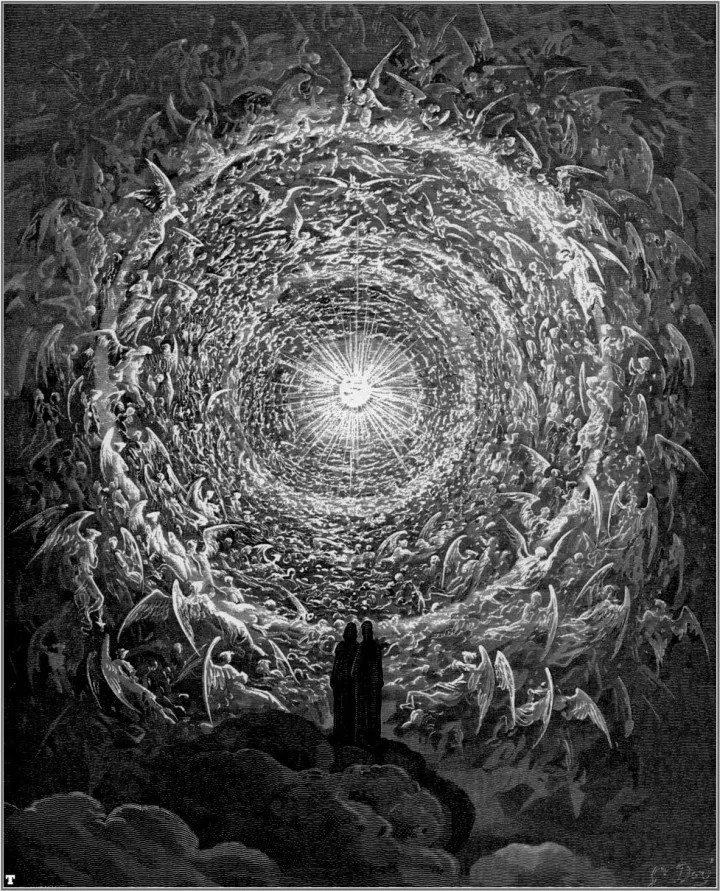
Cover Image: Empyrean by Gustave Dore
 Mete's Personal Blog
Leave a comment