
January 30, 2025:
It’s 2025. “Why am I still alive?” Asked a billion people as an invisible longitude brushed them into the new year. People came; people went. Thoughts vaporized. Faces merged into reflections. But there was one constant: The exhumation of dreams. Watching something dead die all over again. Dreams even deader than last year’s, receding ever further in an antiseptic infinity, forever haunting the present.
Mankind, be vigilant, I loved you – were the last words of Czech communist journalist Julius Fučík before he was murdered by Nazis in 1943. But we were not vigilant. Filth has risen. It has risen on either side of sleep, frothing out of high offices and orifices, facing no resistance. Almost a century after their watch ended, seventy-five million people cry in their graves, roiling at the state of things. What they fought for is dead. Their once-radiant dreams drip from the faces of stars into the mad darkness of space.
Many aeons later, from black gulfs suspended above angular skies, space archaeologists of a better cosmic species will observe our tragic remnants – temples of finance looming above food banks – and either weep their eyes out or burst into laughter at the sight. Maybe they’ll even get to witness the gold-digging ants narrated by the most prized ethnographer of the Occident, Herodotus of Halicarnassus. Perhaps those aureate beasts will finally be observed, sinking their claws and teeth into metallic elements of maximal inertia in a craze of heinous hunger for MORE NET WORTH [Histories 3.105]. And maybe, from even further away, peering through the Orion nebula’s hazy filaments, a crew of galactic wayfarers will finally see the famed akephaloi, or ‘headless men’ described again by Herodotus the Wise [Histories 4.191]. Men whose face was reportedly affixed to their chest – brainless and running on pure endocrine (sound familiar?). Herodotus the prescient clairvoyant of our times – how did thee peer through the mists of time so expertly? How did thee know?!
***
Meanwhile, work is as boring as watching paint dry and my articles and monograph keep stalling into the nether realm. Everything involves so much waiting around while my heart is beating thousands of times every single day. This mismatch is going to be the end of me. I loath viscosity and lethargy. People who walk and talk slowly should be eradicated, particularly the latter. Stop spreading your slow-ass, moronic genes and crawl back into the primordial pool from which thine phenotype first emerged. Be gone yer swine! Other than that, I am slowly carving more slices from between myself and the inevitable inferno. Particularly the revival of the PUBG scene has been helpful in this. Hot-dropping into utter mayhem with JuX0r, erd_GOD the deity, M-ray, Baris, and Kuti-Pie has afforded some great hilarities that are continuously recorded, VC and all, with Nvidia Shadowplay. I’ve spent an inordinate amount of time creating ridiculous clips from these, and there’s still a huge backlog… A highly sophisticated pastime.
These days, in the Great Western Echo Chamber (GWEC), everyone’s busy continuously raging about Trump and Musk (and all the other techno-oligarchs) and the ‘crazy stuff’ they keep saying and doing. How many times can you really get upset at the same thing and still do absolutely nothing? People are strange; always expecting deliverance to come from elsewhere, salivating for salvation, of the effortless and free type. Now where are the guardian angels that sheltered your existence from the horsemen of the apocalypse? Well, I guess the GWEC is finally awakening to what it means to not have any guardian angels, like the entire rest of the world. Every morning when I wake up and prepare to click through the news, I have this juvenile nihilistic glee pirouetting behind my pupils like the harlequin of oblivion, itching to see evidence that we are sinking deeper. Because at the very bottom – the very, very bottom – there might be something better than what we had yesterday. There’s also the singularity lurking in the ever-near future that may replace all our silly worries with new worries and concerns beyond what even the harlequin of oblivion can predict.
February 5, 2025:
The few times in my life when I’ve been forced to wear a suit have caused my lack of faith in mankind to spike to all new highs. I know its not fashionable to complain about men’s etiquette requirements (because women unfortunately have it way worse), but I still need to aerate my annoyance in the dead pages of this mangy blog. First of all: What the fuck is a suit? Seriously, what in the actual fuck is a tie or a rigid jacket or an uncomfortable-ass pair of shoes supposed to be? And don’t get me started on having to tuck-in a shirt. It’s beyond uncomfortable and claustrophobic. I feel like I might die whenever this unnecessary act of sadomasochism is socially thrust upon me. Let’s take a step back: Mankind, at some unfortunate time in the past, invented this form of Victorian torture. Okay, fine. I mean there are many practices and things that were done in the past that today feel absolutely stupid. But for some reason, we still have this shit. And what’s worse, we have what I will forever view as the ‘worst form of human being’ defending it and claiming to ‘like it’. No, you are not allowed to like this shit, because your liking of it enforces it on me! The times I’ve had to wear a suit jacket and a tie and all the rest of that clown attire is only a handful: several weddings and two graduation ceremonies. Thank god, that’s it. But still, what’s meant to be a day of celebration ends up being an uncomfortable wait for the environment’s alcohol and illicit drug levels to rise above the threshold when it becomes socially acceptable to trash the jacket, unfurl the shirt, and fold up the arms – just to get rid of my fabric imprisionment. What a pantomime… If you turn up to an ‘important event’ (so deemed by society) in actually comfortable clothing, you are shunned. It’s not seen as respectable. “What the fuck are you doing? Dress properly you swine!”
Shunning anyone based on appearance has become socially unacceptable, and rightly so. You cannot discriminate based on skin color, weight, amount of make-up, vocal pitch, hair style, disability, et cetera. But what about clothing? Is that not just another appearance vector? How is it still okay to gatekeep based on attire? Our entire social ecosystem is rife with such contradictions, unfortunately. This is yet another one of the reasons why extraterrestrial observers are going to be howling in hysteria at our existence if they ever happen to glimpse our pathetic corner of the galaxy. Anyway, the root cause of this stupidity boils down to my archetypical vent (featured above numerous times) that mankind’s social development lags substantially behind its scientific/technological development. We can split the atom, tunnel through fiberoptics, land on Mars etc., but still wear this uncomfortable shit? And we gaslight each other into thinking this is what respect is? We still can’t organize society and we still aren’t much better – in a social sense – than those living 2000 years ago. But, sure, keep defunding the social sciences…
February 15, 2025:
I recently attended a conference on digital data curation – has a more boring first sentence ever been written? Likely not. But anyway, I was there really attending this thing, like proper presence of mind et cetera, when I was struck by how near me this fellow attendee was. I’d placed my bag on a chair and gone to the bathroom only to return to a slimy looking guy varnishing my eardrum with his snot. He was sitting so close to my chair that whilst I sat back down, I had to place one of my legs on the outside of the table leg. I couldn’t move my chair; I was cornered, he was the one with vast oceans of additional space to his left. But he didn’t move. What’s worse, the presentation began to my right, so we all turned round; now he was behind me, breathing right down my neck, sniffling in my ear. Each time he tried to suction his nasal mucosa down his larynx, he produced this disgusting grunt-sniffle noise that sounded – at my proximity – like a malfunctioning jet engine.
I could feel the ripples his nasty breath was creating in the spacetime continuum distorting the skin along my neck. It was biological warfare. But since the Geneva convention died last year, I had no legal basis against this anthrax like snot-dust pollinating the pores along my neck. So, I decided to whip out my best weapon: politely smiling and doing absolutely nothing. Yes, absolutely nothing. A strange sort of latent indignation mixed with lethargy infiltrated my body – almost as bad as the European left – leaving me unable to resist. Inaction. Psychogenic protest. Someone would hear my silent discontent, surely.
Avalanches of frustration continued to rage across my head, waiting to pounce on any opportunity to flip the narrative. I was not even listening to the presentation. “Is this somehow my fault?” – Maybe it fucking is – “Why the hell don’t I just move somewhere else?” – It’s too late now, silly. It might *look* strange – “God your pathetic, just move.” – No can-do – “That is the lamest reasoning, ever.” – Is it really? – “Yes, in fact, this might be the most pathetically preventable situation to ever happen to anyone.” – … I *am* pathetic.
I was furious, silently and within my own head. Why hadn’t this man simply selected the next seat along, instead of sitting directly adjacent to where my stuff was. I mean, did he not know the Rule of the Urinal (ROTU)? ROTU states that if you enter a bathroom and see someone peeing in a urinal, you must quickly calculate the furthest urinal from the occupied one and use that one. Any breach of this sacred rule is punishable by immediate death. It’s been a law of nature since mankind first invented fire and urinals at approximately the same time. Was this snot-mobile next to me unaware of this? Did he not attend any history lessons at school? Sitting at a table, standing at a bus stop etc. all follow ROTU. ROTU is life. It’s love.
Eventually the presentation ended. And we all turned around semi awkwardly. The guy next to me was chewing curds of crusted snot or his cheek-lining or some other moist nastiness, clearly, since a strange mouth-sound was emanating from his direction. Was this ASMR? God, no. What if I want to hear more snotSMR? After all, I suddenly remembered: I am pathetic. Please god, no… But god couldn’t hear me, likely because of the vortices of mucous rippling across the fabric of reality all around me. Thankfully though, it still sounded vile a few seconds later.
Time to deal with this shit. I said inside my head, very quietly and barely audible even to myself. I turned around to see the guy smiling at me, quite genuinely, his hand flapping in the liminal space that spanned the five centimeters or so separating our seats. Atomized filaments of annoyance aerosolized from the corners of my eyes as I looked at his god-knows-what-crusted hand wobble in my face. It was waiting for me. I had no choice. I literally had no choice. Time slowed down to a trickle, viscous and heavy like nuclear ash. I finally gathered my strength and clasped his clammy appendage, giving a cursory shake accompanied by a gremlin-like band of tautness spanning across my lower face. Is that a fucking smile?
After the hand-shake ordeal was over, I was in dire need of sanitization. Or purification. Maybe even a full cremation. But it would be too awkward to whip out my sanitizer and slather it over my hand mere seconds after shaking his. I was just five centimeters to his right after all. What if we sort of do it discretely? A psychogenic voice wailed from inside of me. Flexing my palm, I could feel molecules of the black plague or whatever he was carrying boring into my skin, tunnelling into each and every pore on my hand. I needed to cleanse. Alas, there was no discretion to be found, biohazard to my left, presentation to my right. I was trapped.
Eventually the presentation ended, and the presenter announced that we would now begin a group activity. This was a workshop-presentation, I remembered, as the horror gradually dawned on me. “Can everyone please partner up with someone sitting next to them?” The presenter’s voice sounded like a foghorn announcing my demise. I was on the corner of the table; nobody to my right, snot-mobile to my left. It was a fun workshop.
February 23, 2025:
I just finished reading Sacred and Terrible Air by Robert Kurvitz. I’d already read a few snippets from the translated PDF, but this week I properly consummated my engagement to this slice of brilliance by reading my freshly-arrived physical copy cover-to-cover. Has hauntology ever been presented so gracefully and with such ingenuity? We follow children doing childish naïve things in a collapsing world, we follow their encounters with grown-ups and with damaged people in a damaged city, we watch them get damaged. It’s really sad and melancholic, but also elegant. We slowly witness a beautiful annihilation, as the world of Elysium is gradually enveloped by the Pale. Such a sublime climax. “There are crackling sounds as the ice edge curves into the sky, wiping gusts like music played backwards and ten times slower. The Pale approaches – an avalanche of memories of the world – and buries matter with reckless speed. The expanse of the starry sky disappears one star at a time under its rolling brush (p. 9).”
Different political outlooks and worldviews and lifestyles deal with the inevitable, overwhelming end of the world in different ways. This is one of the strong points of the novel. And it’s so stylishly written, even in translation – the team did an amazing job, but I bet the Estonian original is even better. Kurvitz’s signature hinge-stop sentences really shine in this coming-of-age saga, in a world where everything beautiful is long destroyed. His style has definitely been influenced by Thomas Pynchon, especially Gravity’s Rainbow, where a similar sentence structuring drives the elegance of the narrative. [Goddamn was that book hard to follow, but it had so many exquisite paragraphs about life et cetera].
There’s a strong thematic focus on snow, likely influenced by the Estonian landscape, which really resonated with me. Many of the ideas presented here are developed further by Kurvitz, Martin Luiga, Argo Tuulik, Helen Hindpere, Kasper Kalvet and Alexander Rostov in Disco Elysium. I’ll end this brief review by quoting this depressing-for-all-parties scene from the book, my favorite sub-arc from the novel: “The linoleum salesman looked at them tenderly, not daring to go down to the beach, close to them. He would turn to ashes if he even touched them. He took pictures. The photons travelled, and the same light that sunburned the girl’s back bounced off her tiny birthmarks and etched onto the pitch-black negative. White dots like stars in the night sky. The shutter speed of memory. He made a linen cord, and a noose, and masturbated. For the last time (p. 89).”
February 25, 2025:
ΨΥΧΗΣ ΙΑΤΡΕΙΟΝ, plastered above the entrance to the Library of Alexandria and other important libraries around the world, translates to “healer of the spirit/soul” – a shortened version of the phrase: ψυχῆς ἰατρὸς τὰ γράμματα. It’s kind of ironic that I’m working in a library back office where there are no books in sight and where I do not deal with anything physical; ironic because I used to really like the archetypical library environment praised by the ancients. If someone had told child-me that I would end up working in a library, I’d probably be thrilled, unaware that almost everything I like about libraries would be obliterated by the unstoppable onslaught of modernity. I still like libraries, but these days the environment is increasingly digitized, modernized and made less book-centric and more screen-centric. In primary school, the library was my safe refuge from chaos, bullying and other juvenile school-crap; it was an ethereal haven where I could hide among the shelves. Solitude. Calmness. And Information. Endless information. Magical information. Before the internet became mainstream, it was fascinating to just pick up and read tomes on everything from space exploration to dinosaurs, and from pre-Cambrian life forms to geological history, and from there to the cold, damp trenches of WWI or into Cold War spy rooms, etc. After all, I was born the year that the Soviet Union collapsed. What I missed fascinated me. It still does. Space exploration and scientific propulsion fueled by political competition and existential dread sounds rad. Anyway. Back to libraries and primary school and pointless erubescence.
The sound-scape was perfect in the library. In our car-centric world where we have polluted the outdoor sound-scape beyond recognition (and we accept this as normal!?), libraries offer the only tranquil spaces accessible to most people. Low volume is important for the mind, as anyone living in Istanbul can confirm. All city-dwellers are semi insane because of this. Anyway, back to the library sound-scape circa 2002. It was basically ASMR before it became mainstream: pages being turned, the odd whisper here and there, gentle keyboard sounds from the front desk, etc. all very soothing and calming. And then I attended Robert College, and there too I found the library quite nice. Stacked bookshelves are so beautiful. I vividly remember reading tomes on SETI like some enchanted dog during my first year (age 14). What a time to be a alive. I was 16 when we first got internet at home. And by then, Wikipedia had become a thing. That’s when the magic of libraries eroded. But only a bit. For when I started university, the library quickly became the nexus of my life. In fact, it was for all students. We would cluster around narrow tables and study like mad – primarily on laptops – but also via pen and paper (esp. if doing fucking Physics homework for the dreaded classical mechanics courses). Goddamn Tonguc Rador…
As I transitioned into my MA degree (in 2015) I slowly began weaning myself off the library. It was around that time that the university library began to feel too kiddie-friendly or in other words, too full of sweaty-ass bachelor students. I needed an upgrade, so I sought refuge in coffee shops. The third-wave coffee scene had sort of semi taken-off in Istanbul by this time and my palette had become annoyingly elevated. The 1-TL brown moisture sold in the canteen did not cut it anymore. I needed coffee out of a high-pressure espresso machine. This requirement intersected with my need for a new work-space (evidently working at home was not an option given our cramped house-sharing arrangements, and also because my gaming rig incessantly taunted me in my room). I ended up spending an inordinate amount of time working in cafes that popped up like flowers all around the university neighborhood.
The coffee spot on the North Campus was where I wrote most of my MA thesis. I made many new friends there. All those moments are now lost in time, like acid rain draining a neon skyline, or aerosolized metal vapor invading a three-year-old’s alveoli. Returning to the present timeline, I find myself back in a library, once again. I’ve gone full circle. Back to the womb. Again I work in a library. But this time for monee. Not as a horsefly waiting to be swatted between the butt cheeks of academia, as was my previous situation. Instead, now I’m waiting to be clapped by the 500-tonne boring-drill commonly referred to as life et cetera. Anyway, it’s upsetting that libraries have morphed into weird, distorted things that have nothing to do with their old atmosphere. Specters of the past haunting the present; Derrida have mercy.
February 27, 2025:
***
Far away from the cosmic summer, a small child sits idly on a low-wall. Somewhere above him, vast coronas of fire reach out into the void of space. Light from their performance travels ninety-three million miles before hitting a cloud of industrial ash just above his head. Overcast grayness. In front of him, across the bay, the black hulls of three dreadnaughts float in formation. Artillery smoke glows in the thousand-watt floodlights sweeping the waves.
The child sits, swinging his heels back and forth against the concrete wall. Leaves rustle beneath awnings weighed down by last night’s disappointment. He turns around. A completely destroyed human being shuffles along the sidewalk, an imprint glowing in her eyes. The kind that appears after a fourteen-hour shift assembling cartridges.
The war economy looms over the city like a sword. Microscopic flakes of Carbon peel off the clouds and fall on the child’s jet-black hair. He sits waiting. Beside him, a malfunctioning generator hums of better times. He waits for darkness. Sweet and beautiful darkness, when he just might see the constellations. Brief gaps in the sky may afford him short glimpses of his favorite systems: Orion, Cassiopeia, Ursula. He cranes his neck.
…
Despite the exhumation of ever-dead dreams that wrap the future in cellophane, I think everybody enjoys the stars, especially those cloudless, moonless nights where the stars shine brighter than the world. A silver linoleum. Perhaps it is because of this, perhaps for entirely other reasons – the tales of the constellations are some of my favorites. They also have eerily uniform origins, often independently. Apparently, the human mind is the same everywhere. We all dream the same way. The same dead dreams.
The stories and legends behind the constellations – such as those associated with Orion, Cassiopeia, Virgo and Ursa Major, my favorite ones – are as old as time, found in distant oral traditions belonging to many different cultures across the ancient globe. They are fascinating and evocative. I will not drag out this blog by featuring them here but I’ve written detailed accounts of their transposition and developmental history that I may place here as a separate post in the coming months. Truly fascinating stuff…
March 4, 2025:
For the first time in a very long while, I was positively surprised by the American circle-jerk simulation often referred to as the ‘stupid fucking Oscars’. Me and Selin had watched Anora back in 2024, when no one had really heard of it yet, and I recall quite enjoying it and actually being able to sit still for its entire length (very unusual for me). The entire film is captivating and well shot and I was ready to dispense a 7 or so out of 10 for its decency, when that final car scene came crashing out of nowhere and just injected some proper feelings into the mix, stunning me into recommending it to people throughout 2024. I was really surprised that it won Best Picture at the Oscars; I mean yes, it’s good and all, but I’m not sure if it’s ‘best film’, but then I look back at the absolute garbage that won Best Film in the past years and Anora easily stands out from the rest of the slop. So, I was indeed pleasantly surprised by the pantomime of American supremacy often referred to as the ‘fucking stupid Oscars’. I must say though, a less known film called Tangerine did what Anora tried to do but earlier (2015) and way better. Of course, the media moguls ignored it, but it’s truly a magical film and deserves all the praise that rubbish films keep sweeping at the sewage treatment convention commonly referred to as the ‘stupid fucking stupid Oscars’. I mean when are absolute gems such as Tangerine or Neon Demon (goddamn vibe) or A Tale of Two Sisters (lit psych-horror) going to burn down the shit-show that keeps occurring in the Oscars.
Speaking of, I was considering what my “favorite films of all time” are, because I’ve sadly watched a boatload and it’s good to sometimes mentally sift through all the crap. I’d never really thought of this in any structured manner before. But after a long think, I’ve identified cinematic productions that I can only describe as the best; completely unmatched experiences. These, then, are my top five films of all time – in no particular order: The Thing (1982), Blade Runner (1982), Tangerine (2015), About Dry Grasses (2023), The Neon Demon (2016). I mean the year 1982 was clearly BIG, but I’ve also been enjoying recent decades too. I could also mention some runner ups, those that did not make the Top 5, but are either cult or classics of excellence: Mulholland Drive (2001), Abluka (2015), Coherence (2013), Get Out (2017), Once Upon a Time in Anatolia (2011), Pearl (2022), A Tale of Two Sisters (2003), Rosemary’s Baby (1968). Now if we venture into the less glammed-up halls of television, the list gets much thinner. Of course, at the very top there is Twin Peaks (1990), to which nothing has since come close to in vibe. Some favorites of recent years are Beef (2023) and Edgerunners (2022). And as far as documentaries go (and I’ve watched a lot), nothing can beat Werner Herzog’s Encounters at the End of the World (2007). So yeah, that’s that. Returning to the start: I suppose it’s nice that Sean Baker finally got the Oscar that he wasn’t even considered for in 2015 with Tangerine.
March 11, 2025:
The other day, I was mindlessly scrolling through Reddit when I stumbled upon a popular AskReddit post asking what act of stranger-kindness people found most important. The top answer involved ‘holding open doors’. This didn’t surprise me since I’ve first-hand witnessed the North American obsession with door-holding, but it was still jarring to read, especially since it was the most upvoted response. Is this really what decency has devolved into? Almost any real ‘act of kindness’ is better than opening a door, since the latter is barely even kindness; it helps so little it’s barely perceptible. It’s nothing-burgers like this that ultimately construct the facade of “pleasant coping” that covers everything in North America (esp. what I saw in Canada): People always smiling (forced to smile by society) even if in deep pain, dying inside or literally suicidal; people holding open doors to unload the burden of doing nothing else for their neighbours; human floodlights beaming virtue-signals across the dark gaps where empathy used to live. A sad situation really. Anyway, to honor this fine, door-holding genus of the human race, I decided to pen this brief scientific description (zero exaggerations):
The feeding ritual of the North American Door-Holder (NADH): A prime specimen of its genus, the NADH is distinguished by its domination of the social ritual surrounding transitory locomotion – that is, all traffic between spaces involving a ‘door’. The NADH exhibits increased forearm musculature, often leading to what is called a ‘calcified grip’ in addition to having a notoriously fierce feeding ritual, referred to as a ‘feeding frenzy’ by zoologists. The ritual consists of four phases, beginning when a regular human thinks about passing through a door. All proximate NADH’s immediately experience a cascade of alpha-waves in their frontal cortex, triggering a psychogenic response that can only be alleviated by aerating a door-frame. This leads to phase one.
Phase 1: The Aeration Phase. The NADH will rapidly ‘translocate’ to the door before anyone else [note the word ‘translocate’ is used here to indicate a form of locomotion unique to NADH’s that is almost too fast to be seen by regular humans]. Once on site, the NADH will use its trunk-like wrist to exert up to 2000 newton-meters of force to open the door and hold it there. This is referred to as the aeration phase and represents the first phase of the feeding ritual.
Once the human victim completes their spatial transition through the aerated frame, the NADH expects immediate verbal recognition of its mastery over phase transition. If this is satisfied the NADH will return to a passive state and the feeding ritual will not proceed. If, on the other hand, the human does not verbalize the desired pass-phrase (rumored to be “thank you”) then the feeding ritual proceeds to phase two.
Phase 2: The Gathering. An uncontrollable subsonic pulse is released from the pores along the NADH’s face, triggering a local response in all other NADH’s in a two kilometer radius. An eruption of energy lines cruise to the site (defined as the point where the feeding ritual is initiated). All affected NADH’s follow these ley-lines and arrive at the ritual within nano-seconds. The regular human is surrounded almost immediately and phase three begins.
Phase 3: Blitzkrieg. Sonic attacks and physical gestures are launched at the victim strategically; the NADH pack operates according to proximity. The closest deploy a range of intimidating gestures and strange facial contortions, while the rear guard offer air support and artillery in the form of sonic bursts and aerosolized mouth water. The victim is almost immediately defeated, leading to phase four; the final stage.
Phase 4: Resonance Cascade. All the sarcastic-aggressive sonic attacks combine into a word salad that the NADH’s will later continue to snack on for hours – this is called a ‘resonance cascade’. There have been reports of some NADH’s snacking on the word salad for days and weeks after the ritual. The typical resonance cascade involves the telling and re-telling of the incident with ever-increasing hyperboles to any and all interested parties. This is the most hallowed phase of the feeding ritual. It is the alpha and omega of the NADH life cycle. If a feeding frenzy reaches full resonance cascade, it may keep a NADH pack satiated for weeks, allowing it to live through a severe drought.
The typical “euro-peasant” or “turkic orc” – to use NADH terminology – offer prime feeding targets for NADHs, for they are unfamiliar with how dangerous the average North American concrete jungle can get during feeding hours. Experts advise foreigners to avoid using doors and instead opt for smoking, eating grass, and being weak – typical European activities that may placate NADHs into not feeding on their undesirable bodies.
March 21, 2025:
Some things are so beautiful that they completely take my breath away. How does a warm evening breeze feel and smell so beautiful? Why does rain sound so… beautiful? And what the fuck are trees? How can something be so elegant, so perfect? How can the rustling of leaves sound so sublime? And what’s with the sky? ῥοδοδάκτυλος Ἠώς? No drugs are necessary to see how beyond beautiful these things are. Get a grip on yourself you fucking embarrassment. No but seriously, I will ignore my inner voice just to say, in fact, to yell, that the earth is indeed a prism of pure, crystalline beauty suspended in an infinite void. A diamond in an ocean of darkness. I don’t think I say this enough. I’m usually so busy complaining and wallowing in my own immiseration and at the state of the literal shit-storm outside of my window, which oscillates around the globe like orbital sewage, that I do not always sufficiently appreciate this particular slice of heaven that we all inhabit. It’s truly mind-melting how fucking elegant it is. I feel it in my core sometimes. I just smile. Smile like a dumb idiot at nothing in particular. At the sky. At the trees. At the slant of sunlight shuttling through 93 million miles of frozen space to arrive at my skin at the perfect temperature. And what about color? I have no idea why we have color vision, but it’s incomprehensibly beautiful. Reality altering. I mean, atmospheric refraction, are you kidding me? You could birth any human into the beam of a sunset and they’d be happy to have lived. Just because of that. It’s unreal. This world is too good. The kindness it shows us is off the cosmic charts. Rest in this. REST IN THIS.
March 25, 2025:
Istanbul, my Queen.
A vice of darkness has held you for so long.
Be vigilant.
I love you.
***
The Queen is awake.
She stirs out of her slumber. Shackled, beaten-up and bereft of allies, but not dead; she cannot be killed. She is every blade of grass dancing the windsong, every bead of perspiration reflecting the stars, every ripple of water, every glint of sunlight, every memory. She is beautiful, and one day she will return, burst free of her chains and illuminate this world once more.
April 6, 2025:
Is existence an illusion? Was Thomas Ligotti right after all? Perhaps – according to new research. Neuroscientists at Caltech have recently shown that the brain is surprisingly slow at processing information. While our sensory organs (the peripheral nervous system) can process thousands of things in parallel, the brain (the central nervous system) can only process one thing at a time. There is no parallel processing in the brain, even though our sensory organs can process thousands of things simultaneously. It’s a huge mismatch. There is currently no explanation for this, but the researchers postulate it may be an evolutionary vestige. What’s certain is that the human brain is unable to process more than about 10-bits per second. That is very low compared to electronic hardware. We are slow and delusional, it turns out. Delusional because we fill in the gaps – a bit like saccadic masking during eye movement, but in this case for all sensory input. We selectively process and fill in our reality. Is this concerning? I’m not sure, but it’s a bit unnerving for sure. Our entire existential reality is effectively a selective construction from an endlessly large and unprocurable sensory bombardment. And it’s an unconscious selection made by the deep psyche lurking beneath the surface. She’s the real driver of our shell; the true owner. Sic mundus creatus est. Quod est superius est sicut quod inferius, et quod inferius est sicut quod est superius.
April 11, 2025:
I’ve recently been semi-obsessed with Annie’s Dark Hearts album, likely a passing fad that will touch the sun and burn in a few weeks, but one reason for my infatuation has been the Lynchian notes sprinkled all over it. The haunting piano music from Twin Peaks – one of the most mood-setting soundtracks in existence – is implanted into several songs and whenever I hear it, it just sweeps me away. I’m not quite sure where to, but somewhere nicer than here. Somewhere more peaceful, more magical. I’m transported into a state reminiscent of hauntology, a term first coined by Derrida and then expanded by the likes of Reynolds and Fisher in several essays. It refers to the idea that in the past, there were multiple possible futures in front of us, but now we’re locked into one (often undesirable) version, and the ghosts of the unmaterialized parallel futures will forever haunt us. This is a very personal term, in my humble opinion. From a political lens, it functions to free the mind of the straightjacket of neoliberalism and imagine the 80s happening differently and the world assuming a vastly different structure. But for me, and particularly in this present context, hauntology is profoundly melancholic. It’s a nostalgia filled grain of sadness fermenting just beneath the crust of my mind. Things such as Twin Peaks or Annie merely bring it to the front, helping it pierce the thick shell that otherwise dulls reality.
**
I’ve said it before, I’ll say it again (first sign of dementia?): I think the tragicomic nature of the human condition is linked to the inevitability of death. We begin to die the moment we are born. The human mind – the most amazing thing in the known universe – is kept alive by a gradually rotting piece of meat; complete perfection trapped inside a shell of rot and decay. The end approaches, inevitable and unstoppable. You are that thing, that jewel, entombed within a skull, slowly but surely draining the life out of an organic heap of garbage that you drag around all your life. That sack of meat will expire, like a battery, freezing the mind in a state of zero entropy. All your memories, all your thoughts and creations, all the ways in which you filtered the universe and distilled reality – so basically you – will be lost. And this is pre-ordained, right from the womb, the moment you are first imprisoned within your cellular cage. What a goddamn situation…!
An absurd situation indeed. The best answer to which I believe remains that given by Albert Camus: Bask in this absurdity, relish it, feed on it. Well, that’s not quite how he said it, but you get the point. And if you don’t, in my humble opinion, Camus’ The Myth of Sisyphus remains the most important piece of philosophical work in existence. Written in 1940 as German tanks swept through the French countryside, and first published in 1942, it is Camus’ excursion into ‘the big question’. According to him, the absurd arises when the human need for meaning meets the ‘unreasonable silence of the universe’. A situation commonly addressed by people through a liquidation of reason in place of faith, religion, et cetera. But Camus handily dismisses a string of other philosophers who ‘cheat’ by avoiding ‘the big question’ with what he calls philosophical suicide, that is choosing unreason (e.g., a turn to God) over reason. For instance, Kierkegaard famously advocated for a ‘leap of faith’ when confronted with the same conundrum as Camus. But need the meaninglessness of life be such a bummer?
A central theme in the Myth of Sisyphus is that despite this absurdity, still, suicide is not the correct answer. The final chapter really drives this point home when we turn to Sisyphus, a figure from Greek mythology who is forced to carry a large rock up a hill only for it roll back down, forever. Sisyphus is of course here a metaphor for all of us; all our meaningless lives spent staffing bland offices and manning the machine, all our struggles and futile attempts at carving something out of nothing. But Sisyphus, just like Camus’ absurd man keeps going on, carrying the rock, time and again. The final sentence of the philosophical tract, “one must imagine Sisyphus happy” is a truly haunting adage. The reason I am so infatuated by Camus and his philosophy is because, in my religion-hating, reason-based worldview, the meaninglessness of the universe is a given. But, unlike what those who make Kierkegaard’s leap of faith may think, this is not necessarily bad. The absurd man knows this, and this is beautiful. There is such spiritual finesse to be found in this.
And this loops right back into Nietzsche’s Dionysian illusion. We need to maintain it to quell the raw, maddening silence of the universe. “We have art in order not to die of the truth.” This is a quote that Camus repeats in Sisyphus. The absurd man knows that time is meaningless. Building something that lasts two centuries or two seconds (like pushing a rock up a hill) is absolutely identical. The absurd man knows this. He is wise and does not care. Just like your borrowed atoms, your building blocks. They are eternal with or without you. They don’t die. You die. They will flutter into the heat death of the universe with an elegance that you and I cannot match nor comprehend. What remains for us then? Epicurean exposition, or art, otherwise referred to as the great illusion that keeps us alive.
I think Lovecraft would have enjoyed and adopted Camus’ philosophy, if he hadn’t had the mischance of living before the penning of this brilliant answer to life, which is not 42, after all. Interestingly and rather unrelated to this, I felt the absurd man reflected in a recent horror game I wormed my way through: Look Outside – a pixelated retro game with a simple but ingenious premise: if you look outside, you die. There’s supposedly some beyond terrifying, absolutely mind-meltingly horrific cosmic entity passing through the solar system for 15 days, and if you glimpse it, you almost instantaneously not only die but also warp into a terrible appendage of the entity. The whole game takes place in a single apartment block, with the windows all covered, and you traverse the various floors, basement and sewers and stuff and encounter all the poor souls who did look outside. It’s a simple but great premise, very Lovecraftian, and the retro art-style and 8-bit soundtrack really drive the atmosphere home. Highly recommend. It’s feeding time…
April 17, 2025:
The root cause of much depression and sadness in today’s world seems to be individualism. This is in itself entwined with neoliberal capitalism, but for now let’s set that aside and focus on ‘the individual’ – something that does not exist according to Spinoza. Man is a social beast. How can you separate the beast from the system in which it exists? Throughout history, humans have organized in groups and collectives and shared solidarity and memory. This is hugely elevating for the psyche, and it has kept us afloat throughout history – but its importance is now purposefully obfuscated in a world order where wellbeing (mental health and all) is secondary to productivity and consumption habits. A happy worker who gets to enjoy the sunrise and feel and think is a bad worker, after all. But the worst worker of all is the ‘social’ worker; one who enjoys solidarity with others, who organizes collectively, who is not living the illusion of being ‘an individual’. So much of the non-Western world could’ve been on such a different path today if it was not for the crushing power of globalization which has spread the plague of individualism everywhere. Billions of people in so-called developed countries are depressed, struggle with anxiety, exist tenuously, etc. And what’s even sadder is that we’ve engrained individualism in our minds so much that the ‘solution’ to this mental health crisis is supposedly to be found in the individual, such as via CBT or other inward-facing means of ‘correcting’ our own brain. In other words, depressed people are gaslit into thinking they have something wrong with them – some sort of wrong outlook – and must find a way to ‘cope better’.
What complete bullshit! But this is what is required to keep the system rolling, so this is what is upheld. The real solution to the mental health crisis is to change the system – something not under discussion. As the likes of David Smail have shown, individuals are pushed into thinking there’s something wrong with their crushing anxiety and debilitating depression – even though it’s shared by many – and they are directed inwards, lest they realize it’s not about them as individuals but about the system in which they live which makes it impossible to not have crushing anxiety. Instead of just coping with the problem in better and increasingly creative and sad ways through things like CBT, the actual solution we need is simple: systemic changes to healthcare, housing, education, social systems, worker rights, along with a clear approach to them. Most of the anxiety and depression people feel stem from these badly-organized systems not satisfying basic human needs. As Smail argues, however much we try these trendy, outlook-correcting, individual therapy techniques, we keep failing because “there is no such thing as an autonomous individual, what powers we have are acquired from and distributed within our social context.”
The funny thing is that even in the Medieval era life was collective, people continuously partook in social groupings of various sizes, shared memories, cultivated solidarity, conversed, and most importantly, they got to exhale their psyche. But today it is seen as bad to unload yourself on a ‘friend’. You’re meant to keep it inside (individualism), instead of collectively dealing with stuff. This is anti-solidarity. And it’s not helped by the fact that a surprisingly large number of people have no friends. Worse still, we’ve invented words to circumvent having even the smallest social escape, such as a “colleague” who is strictly “not a friend.” All these barriers further contract the collective social sphere and box it up into ever controlled sub-spaces. Speaking as a historian with great interest in the psychology and daily life of the Middle Ages, the sad reality I notice is this: A modern American sitting in her large house, all alone, driving to groceries and back, rarely conversing with anyone else except through pre-scripted pleasantries, with internet access, infinite food, modern luxuries and all sorts of mundane entertainment is ultimately in a less enviable position than a Medieval peasant. This is really, really sad. This is anti-progress. While material conditions and many aspects of basic scarcity have been eliminated, we have forgotten that mankind is a social beast and boxed individuals away to rot in what are effectively cages. Everyone’s separated into cages yet everyone’s suffering the same shit. But I guess we all just need to cope better, cope harder, cope alone.
Take this observation from Jennifer M. Silva – that I encountered via Mark Fisher – which is just pure gold: “In social movements like feminism, self-awareness, or naming one’s problems, was the first step to radical collective awareness. For this generation, it is the only step, completely detached from any kind of solidarity; while they struggle with similar, and structurally rooted problems, there is no sense of ‘we’. The possibility of collective politicization through naming one’s suffering is easily subsumed within these larger structures of domination because others who struggle are not seen as fellow sufferers but as objects of scorn.”
April 25, 2025:
It was looking straight at me. The small bathroom mirror did not afford a very wide field of view, but it was enough to see the face behind me, staring at me intently. What lay beneath that face? What lurked beneath its lidless eyes? Why were its dark red pupils scintillating in anticipation? – I did not know. But I had some idea. Eliza had told me about it, years ago, before her passing. I knew that turning around was not an option. Because that’s when they get you. That’s how they’d gotten her. “I mustn’t turn around” I muttered, needlessly aloud.
In my state of fright, I’d left the hot tap on, and steam was rapidly obstructing my view. But just before the mirror became functionally useless, I glimpsed movement in it. The eyes were wobbling, and I also noticed that they were running down the face like ocular yolk. I could hear them dripping on the floor behind me, even as my view was wholly blurred. “I mustn’t turn round” I repeated, rubbing the mirror with the back of my sleeve to regain vision. But all I could now see was my own stupid face, gaping back at me. The entity was gone. I noticed how bloodshot my own pupils looked. Lack of sleep was really taking its toll. I turned the lights off and left the bathroom, thankful to still be alive. In fact, I felt rejuvenated. As I tucked myself in bed, I felt like I’d been born anew.
May 4, 2025:
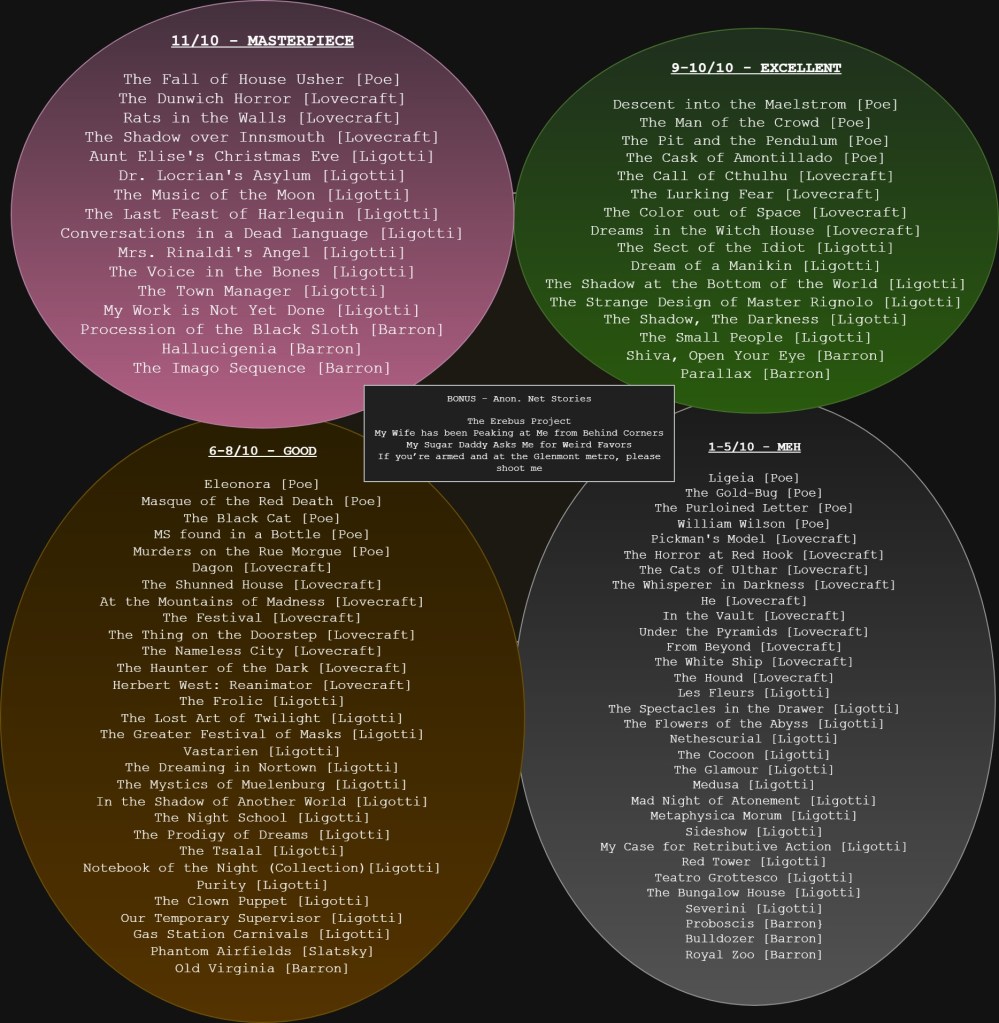
Limbless children starving in Gaza, Beyonce’s new dress, Elon’s latest Tweet, et cetera, the reel turns – our species hums on, waiting for a galactic fissure to open up and swallow it whole. Meanwhile, already-scarce academic job postings seem to be slimming into the two-dimensions this year, almost thin enough to seep through the cracks in my dreams and fertilize the emptiness. The grotesque shadows are feral tonight. Speaking of, I’ve been having a goddamn awesome time experiencing some rad-ass new horror stories lately. After crawling through Ligottian darkness in Noctuary and The Spectral Link through March and April (which was also great), I’ve now embarked on my Laird Barron journey. I picked up The Imago Sequence after seeing some comparisons with Ligotti. And I was immediately stunned. Barron’s mind is like a rift upon this world, a refulgence dispensing the black pits between the stars, where cosmic dread whispers of the Great Old Darkness. Truly haunting. Beautiful and terrible. Procession of the Black Sloth is a masterpiece in horror literature, as is Hallucigenia. Barron’s prose is also beyond this world. He has immediately entered the list of my favorite authors, unlike Christopher Slatsky or John Langan, neither of which chimed with me. Particularly Langan’s The Fisherman was a sore disappointment after seeing it praised to high heavens online. But Barron was the opposite. I will likely obsess over his oeuvre for the next few months. Goddamn, where do they create these people? Anyway here is my little graphic on the cosmic horror scene and how I feel about some tales that represent it:
***
May 7, 2025:
Something is staring me in the face, brighter than the sun, bigger than God. A spectacular visage composed of millions upon billions of microscopic meta-critique particles. An insatiable, chitinous membrane that subsumes all in its wake. No censorship is necessary or even possible with so much appetite; simply subsume absolutely everything like a black hole. Oh, what’s that? A new Joker movie? Hell, yeah! DANCE ON BURNING CARS, TEAR DOWN THE SYSTEM. And what do we have here? Black Mirror? WOW SO PRESCIENT. Critique, critique, critique. Where’s the series about Luigi at? Won’t watch it unless Henry Cavill is Luigi. Am I salivating? Or are these mouth tears? Molly? Wait what?! What did you just say? WHAT THE FUCK? Remember about the great sundering man! Get a grip on it. Critique and praxis are eternally separated. REMEMBER! An infinite chasm divides them, within which a million demons and other hell-born entities consume dried viscera flayed off from those who dared combine them. Yummy ex-human macromolecules roasted upon pyres of howling darkness. Point is: NEVER FORGET THE SEPARATION! Breathe calmly and recite our sacred motto: “Think; Don’t do!” What…? Did you just say… ‘Organize‘?! WHAT THE FUCK, MAN! GET A GRIP ON IT, YOU HAVE TO WORK TOMORROW AND THE NEXT DAY AND THE NEXT DAY AND THE NEXT DAY AND THE NEXT DAY.
May 23, 2025:
Remember those gray plastic electronics of the 90s? Every device looked the same, and it feels so nostalgic to me today. I have these rose-tinted memories of them bulky cathode ray monitors and thick keyboards (with satisfyingly deep key presses) and those twin-buttoned bricks we called mouses, all in that same drab-gray color that died alongside the second millennium. Kids these days don’t know the joys of degaussing a CRT monitor, of swiping a Red Alert floppy disk, or of the famed 56K dial-up modem and its connecting cries (which disabled the phone-line while in use). I wish I still had some of that goddamn memorabilia… But just think, the Soviet space program (SSSR) had put a man in orbit three decades before that. When you look at the Soviet and American space programs through a lens of how 90s technology feels today, it becomes doubly remarkable. How on earth (pun int.) did the SSSR manage to put Gagarin in orbit around the earth with 1961 technology? Fascinating indeed. Reading the mission’s transmission minutes and how Gagarin himself was troubleshooting while in fucking orbit over Africa is mind-boggling. A lot of credit for the SSSR of course goes to rocket scientist Konstantin Tsiolkovsky and engineer Sergey Korolev – absolute madmen and geniuses (their life stories are WILD). Of course, I admire the NASA programs that led to many fascinating discoveries, but the Sputnik and Vostok programs, the constructions of the ISS, and other such Soviet engineering feats are stunning to find out about and they definitely do not get enough attention in the Western media orbit that I’m begrudgingly and unfortunately embedded within. Anyway, I recently procured a commemorative silver coin depicting Yuri Gagarin, a limited mint struck in 2021 for the 50th anniversary of his orbital voyage. Such a pointless, materialistic trifle, but I unapologetically bought the fucker online. It arrived today and Mr. Gagarin is indeed looking silvery in my coin drawer (right beside my low-denomination Byzantine coins screaming of a more interesting Medieval life each time I behold them). I must polish them and also my trigger-finger since it’s got a bit rusty buying completely unnecessary ephemera online. Bad habit. BAD HABIT.
May 26, 2025:
Outside, on the street, it becomes glaringly obvious that mankind only recently effloresced out of some base simian stock, before rapidly finding himself waiting in line at a bus-stop or at a grocer’s till, ever-ready to shake off his newfound dignity and devolve back down his taxonomic phylum. The state of things is dire. Intellect and reason are afterthoughts for the feral beasts that comb the streets howling at the moon, transfixed in some primitive voodoo ritual. This specimen perfectly illustrates mankind’s present trajectory and can be found everywhere, from the streets of the Hague to the London underground, from mosque yards in Istanbul to yard sales on the Pacific seaboard. He is an otherwise elegant distillation of human evolution – what could have been a rune of pure beauty – lobotomized and herded into the basest coagulation of the mammalian condition. Blind emotion guides his whole life, gyrating on an infinite edge like a spinning top waiting to topple, powering locomotion, laryngeal kinematics, and other base acts. Regarded en masse, this blackened accretion is an infection upon the planet, painting the most pathetic canvas seen under these stars. Although I will admit that the devolution of society is a recurrent theme in history, this time we are properly spiraling into the formless abyss. There we will find nothing but conflict and suffering, nothing but the worst sublimate left over from the human experience. The final condensation of humanity, to be wiped away by the galactic doorman.
Yeah… so this is a rough but fairly accurate summary of the thought process accompanying my short, 10-minute walk home from the tram today. You get the picture. But beyond the disintegration of our species and planet yada yada et cetera – it is possible to talk about some less gloomy things. One such slice of joy has lately been Kingdom Come: Deliverance II, Warhorse’s historical RPG which has such beautifully immersive and fairly accurate depictions of life in fourteenth century Bohemia that my Medieval heart has been elevated a dimension or two. They’ve also nailed the weather – rain and thunder look and sound so atmospheric and moody over the hills near Kuttenberg. And the rustling of trees as rain patters upon the forest north of Trotsky Castle is just a vibe that I did not know I needed in my life. [Maximum graphics on my new rig also helps of course. Thank you, salary bonus.] I’ve always had eclectic fascinations, and this game ticks several of those: blacksmithing, grave-digging and Medieval graveyard keepers in general, pre-modern alchemy, tanning and the Medieval leather industry, the folklore of wayside shrines, the legends of charcoal burners and other professions on the rim of civilization (grave-keepers or so factor in here, along with many others). KCD obviously does not have encyclopedic knowledge of all these things, but as a historian with great interest in them, seeing them depicted and animated in a game (for good or bad) is enjoyable in itself. It’s enjoyable chiefly because I’m able to fill in the dark gaps myself. I can weave stories and horrors and mischief into the cracks in the official storyline, into the innocent villagers and maidens and damsels and smithies and tavern-keepers. Time and again have I mentioned my adoration of everything with high suggestive potential, and an undulating Medieval forest or a hillside shrine on a stormy night can scarcely be contained in the luminous alcoves that line my brain and play dreamy reels of fascination behind my eyes all day. So yes, KCD has been a fine pleasure lately.
May 27, 2025:
Do I love H. P. Lovecraft? Not Mr. Lovecraft the master weaver of cosmic fright, but little Howard, the odd kid from Rhode Island with a magnetic imagination stranger than god? Let’s see… Many of his writings have been posthumously published, including thousands of letters, essays, miscellaneous scribblings, and many private notes, diaries, and journals. Now, I have already commented on the excellence of some of his essays (Supernatural Horror in Literature is a classic, as are On Materialism, Cats and Dogs, The Defence Opens, and many others – go read them if you haven’t). I have also previously praised his letters. I’ve read 4 volumes of his letters so far: two general compilations and two focusing on just his correspondence with Clark Ashton Smith, one of his pen-pals and fellow weird fiction writer. The letters do not disappoint. Howard is humorous and sweet, and you really see the human being behind the grafter of nightmares that we all known him for today. For instance, he signs his letters to Smith as various entities from his Cthulhu cycle, or as E’ch-Pi-El (as in HPL; his initials), or simply as Grandpa, and likewise addresses his friends with ever-creative salutations, such as High Priest Klarkash-Ton for Clark Ashton Smith. His signoffs are also legendary, things like: “regards from the seventh nebula beyond the black gates of Yuggloth.”
But what has recently intrigued me are his informal scribblings; lists, notes, diary entries, autobiographies, and other miscellanea painstakingly collected from hand-written papers found after his death. For instance, in the year of 1925 he recorded his entire year, day by day, in a brief “what I did” sort of list (each entry only a line or two). Several interesting observations follow: We see that Lovecraft preferred writing at night and had a very irregular sleep schedule, sometimes staying awake till the morning reading/writing and then going to bed at 6 AM or so, rising early or at noon or in the afternoon depending on his mood. He reportedly had the best imaginative sprints deep in the night, when he wrote profusely. Some of his days are just: “Rose early – wrote letters all day – retired late.” We also glimpse his colorful social life whether via letters or physically.
But what is most interesting I think are his little scribblings on things that we today know developed into masterpieces. In 1919, in a brief entry in his handwritten ‘story ideas’ booklet he noted “Man visits museum of antiquities, asks that it accepts a bas-relief he has just made (in his dreams). Old and learned curator laughs at him.” This is the basic premise of The Call of Cthulhu, written seven years later; one of the most influential short stories ever written. And there are hundreds and hundreds of these ‘idea’ scribblings, many of which unfortunately never came to fruition (he died at the age of 46) but you can see kernels of pure gold hidden there, things that we never got but which were brewing in Lovecraft’s webbed cranium. Such a shame! Here are some examples from the thousands of story-germs found in his notepad:
–Wallpaper cracks off in sinister shape – man dies of fright [This would become Rats in the Walls].
–Man forced to take shelter in strange house. Host has thick beard and dark glasses. Retires. In night guest rises and sees host’s clothes lying about – also his mask, which was the apparent face of whatever the host was. Flight. [This would become The Whisperer in Darkness].
And some examples from the hundreds which never came to fruition:
-Black winged thing flies into one’s house at night. Cannot be found or identified – subtle developments ensue.
-Man enters (supposedly) own house in pitch dark. Feels way to room and shuts door behind him. Strange horrors.
-Disturbing conviction that all life is only a deceptive dream with some dismal or sinister horror lurking behind.
-A secret living thing kept and fed in an old house.
-Black cat near dark gulf of ancient inn yard. Invites artist to nighted mysteries beyond.
-Steepled town seen from afar at sunset – does not light up at night. Sail has been seen putting out to sea.
-Vague lights, geometrical figures, etc., seen on retina when eyes are closed. Caused by rays from other dimensions acting on optic nerve? Man afraid to shut eyes.
-In ancient, buried city a man finds a mouldering prehistoric document in English and in his own handwriting.
-Ancient house with blackened pictures on the walls – so obscured that their subjects cannot be deciphered.
-Pane of peculiar looking glass in a ruined monastery through which the landscape looks vaguely wrong.
If only he’d lived to compose another hundred or so tales… Interestingly, until reading through his notes I never knew that he usually created two story outlines: one for the chronology of the story, and one for the ordering that he would tell it in, thereby placing all the background fluff, genealogical and familial characteristics et cetera on a solid footing before starting on the mss. [If only we could all be so organized].
Much later in his life (a few years before his death), he drafted several groupings for his story catalog, stating that if ever his stories were published as collections this is how he envisaged them being grouped, but also adding that “of course such a publication is unlikely to ever happen.” Howard, you gremlin, did you really have no idea of the colossus you would become? Sadly, Lovecraft died with relatively little recognition, his stories published only in pulp magazines (chiefly Weird Tales), while he got by with some editorial work and ghost-writing. Little did he know that decades later he would become not just a household name, but an entire genre of horror. Today, if you go to Steam, the biggest retailer and library of video games, there is a category called ‘Lovecraftian’ which when clicked shows about two-thousand titles assigned to it. Names of things he invented such as Cthulhu, Arkham, Necronomicon, etc., live on in countless media, even in unrelated genres such as the Batman franchise. Lovecraft’s mythos is also among the most popular setting for board games, and his cosmos is continuously expanded by modern acolytes of horror fiction. There is not a single horror author alive today who was not influenced in one way or another by his output. His literary philosophy is sometimes called ‘cosmic horror’, and it is one of the most profound and interesting genres of fiction in existence, enjoying a particular efflorescence these days.
In sum, little Howard from Rhode Island with his odd-shaped face became the alpha and omega of atmospheric horror. All that to say: It is really heart-wrenching to see this master conjurer perish absolutely unaware of how impactful he would become and how he would indeed be counted among the classics that he so adored. For instance, in one of his notes he states that, in his opinion, the greatest supernatural horror tale ever written is Algernon Blackwood’s The Willows. Now that isn’t a bad tale by any means, in fact it’s quite good, but currently most people on the street have never heard of Blackwood, but countless millions have heard the name Lovecraft. Whether or not they’ve actually read anything of his, people still know his name and associate him with horror and the weird aesthetic. It is saddening to read his autobiographies entitled things like “Life of an Inconsequential Scribbler” and “Autobiography of a Non-Entity” (these are actual titles he gave to two brief autobiographies he penned upon request in the 1930s). I feel sad for a man I never knew, who died in his forties, mainly because I find it so upsetting that he died unaware that he was, in fact, the polar opposite of ‘inconsequential’. I have this strange desire to teleport back in time and tell him this. Might sneak in a brief hug too.
But we must never forget: “that is not dead which can eternal lie, and with strange aeons even death may die.” [And yes, I know he had some racist views, I mean I’ve read millions of words by him, and yes, I’m a Turkic ‘Orc’ according to his anthropology, but I don’t mind it, and it does not diminish my love for his boundless imagination and intellect and passion. After all, no one is perfect. Plus, those were the 1920s.]
June 23, 2025:
Summer has… been ongoing. Mankind has been treated to a wonderful return back to the stone age of nuclear proliferation coupled with a glorious rise in suffering, anti-intellectualism, and state-level bullying as we sink deeper into the viscous quagmire of the 20s. Speaking of absolutely wonderful things – in our recent weekend get-away to Paris, Selin fed me literal shit (i.e., andouillette, which she ordered and then refused to even try despite me already having eaten several mouthfuls even as I cursed all the dark gods for being alive – what a backstab!). We mouthed many croissants and haughty words along twisting Parisian streets where bygone communards had fanned the flames of justice as reactionaries quartered them in droves. I also had an interview for a postdoc position in Brussels (on route of our train journey there), which I’ve since been rejected for; a nostalgic pastime. Then a week later, we embarked on a voyage to Málaga in southern Spain – from where I now compose this gabble. We immediately fell in love with botani moscatel wine produced here in Málaga, a crystalline liquid of most prominent succulence. The sea is enjoyable and it’s not too hot thankfully, Greta-be-praised. Upon Selin’s request, we are taking the whole siesta idea very seriously, working indoors in our AirBnB during the hottest times, and venturing outside on either side of the solar apex. Unfortunately, I just received news that my SNSF 2025 re-application also remained just slightly below the funding cut-off score… “This is an excellent project that benefitted from a thorough revision of a previous version. As such, the proposal submitted is of unquestionable excellence and extremely persuasive. The project goes far beyond current state of the art, present a radically original approach to a fascinating topic that could not be studied in so much depth and comprehensiveness in any other way.” This is what the reviewer said about my project, which thus remains unfunded much to my amusement.
Meanwhile, my inspection of various ruins and sites in the region of Andalusia have led to several curiosity-satiating discoveries. In turns out that a team of speleologists exploring a cave in Alozaina (Las Tres Tinajas) came across four pottery vessels of prehistoric appearance arranged in what seemed to be their original location, at the bottom of a deep 42-meter sinkhole. Now I think it is fairly obvious to the acute mind that this is clearly evidence of them. Those accursed ones that walked the mantle of our magma-encased planet aeons ago and who still whisper at us from between the cracks. Another curious spillover from prehistory is the megalithic tomb tradition often attributed to a race of giants who roamed the earth in the mists of time. The 17th century intellectual, Francisco de Tejada y Nava, considered them to be “made by supernatural beings in which men performed sacrifices or demonic rituals” and who are we to doubt him. These sort of thangs are ripe material for a haunting tale of woe and horror – TO BE WRITTEN. But more so, I wonder if Herodotus’ ancient bestiary was somehow influenced by such Mediterranean tales of cosmic wonder; giants lifting world sized rocks to see man-sized ants hunting little headless men with faces carved into their chest cavities. Gaben-be-praised am I happy that Valve capitalized on Antlions in Half Life II – more modern media needs to popularize Herodotus, the best story-teller of the Occident. But instead, all we have is Ralph Fiennes fawning over Herodotus in the English Patient, which was not a bad display but remains insufficient for a Herodolover like myself.
**
Cover Image: Rime of the Ancient Mariner illustration by Gustave Dore
 Mete's Personal Blog

Leave a comment