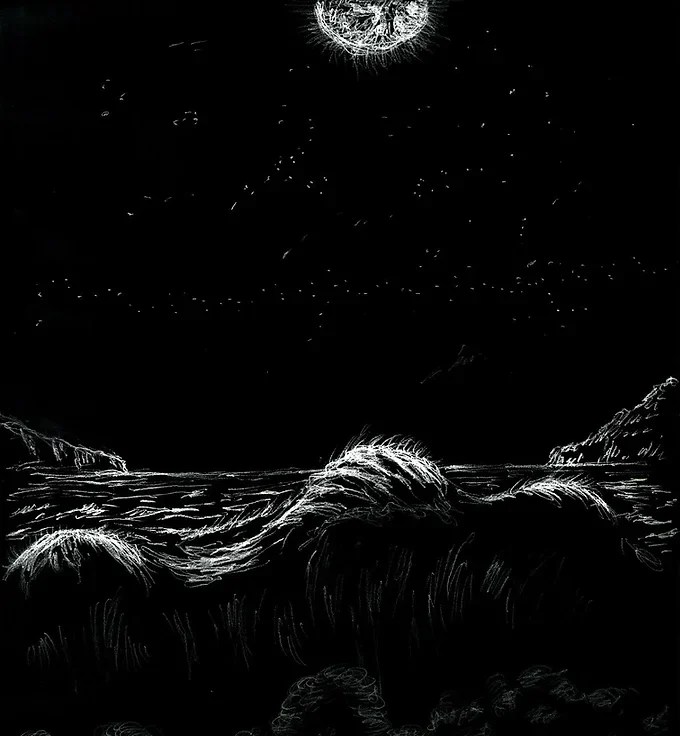
Daughter of Anatolia
A Short Story by C. M. Oguz
***
It’s a cold winter’s evening in Istanbul. A dockworker waiting for the nightshift rests his forearms against the rusty black railings of the Eminönü waterfront, gazing idly across the inlet. Karaköy looms ahead, streaks of color illuminating its glass vertices. Large edifices of concrete pierce the urban glow, muted by the approaching storm clouds preparing to deliver a flurry of snowflakes. They will die as they touch the city. The man mutters, coughing something up from his lungs and spitting it into the roiling waves.
To his left he can make out the silhouette of several fishermen standing on the Galata Bridge like statues, their slender rods dangling into the tarry waters of the Golden Horn. He glimpses their faces only in the glow of an occasional, passing headlight. Their featureless faces peer into the sea, transfixed as if watching something massive move beneath the waves, something ancient and hungry.
He stares further into the distance, through the metropolitan mantle of smog, well beyond the pale haze of pollution, to a point where constellations of light glitter along a darkened horizon. The city is wide awake. Countless bodies wander its streets, their tall shadows contorting like marionettes.
Time to go; the nightshift begins. He turns around slowly, his willpower fueled only by a burning commitment to offer a better life to his daughter. By sunrise, he is overwhelmed with exhaustion. All he wants is to sleep forever. But the traffic is terrible, as usual. People avoid sitting next to him on the bus, his hacking cough acting as a social buffer. He decides to walk the final stretch home.
Somewhere far below him, in the unbroken darkness underneath the city, a subterranean mass whispers his name. He can hear it only in the split-second when the wind changes direction. The city only calls those it has nearly finished consuming. For centuries it has fed upon longing, ingesting every expression of grief, every unrealized ambition, every burning disappointment. Layer upon layer, century upon century, these human sediments have accumulated until something vast and formless has begun to stir beneath the streets.
He is eventually greeted at the front door by his daughter, her five-year-old heart full of excitement. And love. Her vascular little heart pulses with affection. She gazes deep into her father’s eyes, bloodshot with the burden of duty. He used to smile, play with her, laugh with her. Now, his vacuous pupils are framed by a corona of darkness. She whispers into his ear. Softly at first, barely audible, asking about his day. Then again, a little louder, growing frustrated. But he cannot communicate, not anymore. Throat cancer makes it too painful to talk. She knows that he’s slipping away, but blocks the thought with all her heart, unaware of how rapidly her life will be violated; orphaned at five and on the streets by six.
***
Another year passes in the city, a slow and viscous year. The following winter, one cold February afternoon, hundreds of little fish dart about beneath Galata Bridge. Above them, a lone fisherman slowly gyrates a metal rod, sending glints of sunlight downstream, past dozens of rickety shallops, and into a makeshift shack on the back streets of Karaköy. Inside it, a small child lies shivering. Her stomach hurts. It’s been hurting for weeks. She has no idea why, but wishes it would stop, so she cries. Rivulets of distress bleed out of her pupils, still sparkling with hope and naivety. She’s confused. The remnants of a lost childhood drip out of her eyes, but she’s unable to discern what it is. No one hears her, except for all those who choose not to. Hundreds of people pass by, all caught up in their own concerns. No one looks directly at her, but waves of peripheral vision continuously sweep over her. She’s too upsetting to fully acknowledge.
She eventually steps out onto the crowded street, surveying her surroundings, inhaling the city. The air resonates with energy. Fumes of diesel gently caress the tattered hem of her green dress, a dress which had once been so beautiful. Several streets down, she can see the port of Karaköy leaning against the Bosphorus. Scores of people spill out of the ships periodically docking at its small jetties. Nearby cafés bustle with activity. Hundreds of faces bask in the last rays of a fading twilight, staring vacantly into the enveloping night. The city is enchanting.
A child roams the streets, a void gnawing through her distended stomach. She heads to the busy intersection at the Galata ramp, near the underpass leading to the funicular, and approaches the large trash containers. But she isn’t quite tall enough to reach in. So, she climbs onto a nearby wall and hurls herself inside, unfazed by the acidic stench. Perhaps a discarded piece of bread will alight her face. She searches inside the container, scuffling about, desperately scanning the darkness with pupils as big as the sun, soldering a canvas of human waste onto her enlarged retinas. She cannot afford to miss anything edible.
Outside the container, the city thrums with entropy. Nighttime is when it gets to shine at the stars, when its anthropic miasma gets to bellow into the sky. But the stars can no longer shine back εις την πόλιν. The city is too bright. It glares out to Anatolia, where distant woodlands and snowy meadows lie in slumber. Two and a half thousand years grin back through the fluttering leaves of an ancient conifer forest.
In a stuffy one-room apartment overlooking the mayhem at the intersection, an ambitious high-school student wraps up a ten-hour cramming session, bleeding away his will to live. The prospects of a university degree mock him from the safety of his dreams. His anxiety joins millions of others drifting invisibly through the city, nourishment for something vast and sleepless.
Vendors lining the Galata underpass can be heard continuously shouting out to customers. Many are near the end of twelve-hour shifts, agitated and tired, their eyes burning in the fluorescent white lights that glare above them. Hundreds of plastic commodities glare out from overstuffed shelves, bright and meaningless household items, cheap electronics, and strange toys. Almost everyone ignores this urban void and shuffles along the tunnel of human meat, except for those who brave the intersection above, where car horns continuously pollute the air with the ripples of pandemonium. The city is disintegrating. The underpass is falling apart, its walls are full of cracks, some much larger than others, descending deeper than physics would allow.
***
Triangulating a lack of energy with dehydration and late-stage liver failure, the small girl slowly succumbs to the city. She is unaware of her ailment, unaware that this was not the life she deserved. This was not the life her mother had envisioned as she gave birth to a bubbly baby with gleaming eyes and the sweetest of smiles. This was not what her father had worked for. Her eyelids slowly sweep the pain away, drifting shut as the stench of human trash lulls her olfactory core. Her head rests against an empty five-litre bottle of water, having created a minuscule head-shaped caving on its plastic surface. It’s a small head after all; she’s only six years old. She falls asleep, a hauntingly conclusive sleep, where she dreams of people she never met and of things she never got to see.
Her body is not discovered until it nearly blocks the intake chute of a garbage disposal truck the next morning. No one mourns her. No one even knows her name. But somewhere distant, far away from the cold asphalt of the city, a gust of wind embroiders her name across a golden mountain crest. And eventually, solar winds will carry her beyond this world.
Next morning, it’s bright and vibrant in the city. The winter sun bounces off windshields, billboards, and a million other screens and reflectors, a ricochet of starlight whizzing through the streets. Scores of people mill about the glowing megapolis, stimulated by its endless appetite, mistaking it as inanimate, thinking it their property. The dead child is quickly replaced in form and function by others, much like a rapidly healing patch of scar tissue. The city is frothing with human energy, an integer overflow clogging its lungs with the vox populi. Millions of talking creatures keep it in constant flux, each sound they make absorbed by a vast and ravenous entity. The city’s mouth hangs wide open, ventilating the urban haze.
A couple of months later, one April’s afternoon, an orange sun looms over an inner-city slum. An unmarked patch of soil in a pauper’s grave lies beneath a nearby highway ramp. It’s such a small patch. She is so small. The integrity of her soft body has been violated by the passage of time. Chemical weathering has taken its toll. She has become the freshest and purest necrosol, an anthropic soil germinating new life. But something beautiful eventually rears its head, and over time, tens of others join it. An element-rich soil continuously fertilizes the free-form flowers that slowly pop up within it. Within her. She is a tiny reservoir of life, rich in nitrogen, phosphorous and carbon, gently morphing into new shapes.
All the while, to the east, across the Bosphorus, far beyond concrete horizons and industrial corridors, twenty million hectares of forest undulate in the wind. Something stirs out there. Something older than emperors. Older than cities and temples. Older than memory. Far underground, a great seam pulls tight, rippling toward the city.
Anatolia is awake. She’s reaching for her daughter.
 Mete's Personal Blog
Leave a comment