December 39, 2025:
It’s well into 2026 at the moment, but it feels like we’re in retrograde so I’m having a hard time advancing the year counter. I think the saddest thing of all is that we completely lack hope. From 1848 until the 21st millennium, humanity had some form of viable alternative to the world order, even as the latter continuously dismantled dignity and happiness around the globe. Children were born into a world where hope was still alive, even if just barely, and young adults, eyes yet full of starlight and not dulled by the immiseration of life, could still imagine a better future as they blinked through an overlay of dream, or they could pick up a pen, pamphlet or rifle in the name of something better. The option was there, and as anyone in a situation of hopelessness knows, Hope is the foundation of all happiness and every positive emotion in the world. She is sinister yet all-powerful, since her mere existence, however distant, is enough to elate millions upon billions. She’s like the sun – you do not need to look at her to see her. When alive, she cannot not be seen. You know she’s there and you can breathe again. Nothing else has this power. Hope is Tinúviel dancing in Morgoth’s court, surrounded by absolute darkness, deep in the caverns of Angband. You’d think hope should be immortal. But she wasn’t. She’s gone now. She left this world for somewhere nicer. We have nothing now. The demon is omnipresent and politics is dead. It died a few decades back, but its funeral was truly held these past few years.
Nowadays what are children or emerging minds supposed to aspire to? Initially, as humans first developed cognition and formed civilizations, Hope was bright in the sky, white and luminous. Her heart swelled with possibilities, all good avenues that could be taken – so many opportunities, so many beautiful futures. But by the nineteenth century, watching us, she got severely disillusioned and turned bright red in protest, mirroring our blood. She became the crimson star, fluttering in the night sky, barely visible at times, yet always there, reminding mankind that something better is possible. But we murdered and grave-stomped her. She’s gone now – gone far away. Now there is only darkness where her star once pulsed. Red rotted into black and an enormous void has now emerged where once she shone with all her glory, where billions of children, workers, farmers gazed up for solace, for hope, and for their next breath. That void now continuously siphons the hopes and futures of those still born in this abandoned world, tangled up in the dark bowels of evil, suffering, and inequality from birth to death. What sort of rescue operation is even possible for the rigged idiocy that we call the modern world ‘order’? Anyway, maybe they will finally come for us.
***
February 7, 2026:
After the interesting week where we got a boatload of snow in Rotterdam (a boatload compared to what is normal), now the usual god-forsaken cobwebs of gloom have draped their sinewy tendrils all across the skybox once again. That snow saga was indeed a hilarity in its own right. First off, everything ground to a halt with what was not even that much snow – I received a code orange warning message from Leiden University to “not even dare coming to work” because of the “terrific volume of snow” (it was like maybe 5cm max). And when I flung myself outside, because I’m a sucker for some snow action, I spotted one of the most pathetic sights known to mankind: It was a one-man sized vehicle (you know those microcars, one-person wide) with a snow-plough attached to its front, ploughing the road really slowly and basically entirely ineffectively. Apparently, this is all the Rotterdam municipality has to clear snow. It seriously looked like a toy. The things snow does to a city’s dignity… I was also slightly concerned for the geese in front of my window (by the canal), since -10 Celsius seemed a tad nippy for them and the entire canal froze over so they could not chillax in the warmer water. But then I thought fuck them, because they are indeed a strange bunch of little fuckers. I mean, wouldn’t you agree that there is something profoundly strange about geese? It almost feels like they are aliens or mind-controlling droids softening us up for the eventual goose-o-calpyse. IDK but there is definitely something deeply, deeply disturbing about these goddamn geese, sitting around there all sus, day and night, without any chill, quacking away at 3AM. W.h.a.t.e.v.s.
Beyond that, working on three different articles in addition to the final CUP manuscript, and also delivering a course at the BAIS institute is keeping me busy. I’m striving to really push everything work-related to the maximum when I’m not with Selin, since (1) being occupied makes it more bearable, and (2) I can have more free time when I’m with her. She visited me last week and we had a complete blast. Rotterdam was ours. Our kingdom. We wined and dined through it like the royalty that we are. I basically didn’t work at all that week. Wish I could just live that week on repeat, forever. In addition to many other things, we also binge-watched all four currently released episodes of Bridgerton Season 4 in one sitting. I cannot believe we now have to wait a month to see the rest… It was the most captivated I’ve been watching something in a long while, much to my surprise. Ohh you will never guess what else happened last week: the Epstein files were released (or at least some of them) and the typical clod decided it was now finally time to have a meltdown. Meanwhile, anyone with half a brain knows that we did not actually learn anything new. All billionaires and super-rich people being bad is not news. I mean, who would’ve thought, right? What a shocker. If you sit for one single second and consider what a billion is and then think of what a million is and then just sort of stew in the concept of numbers and magnitudes etc. it is pretty easy to see that anyone with that sort of accumulation is inherently and by default an evil fucking person. Oh, wow, Bill Gates or whoever-else-the-fuck-you-thought-was-not-evil, apparently went to Epstein’s mansion and molested kids or women or whatever, and played dirty, and did all other sorts of shit… how shocking. Would never have guessed. Anyway, I’ll just continue reading Barron’s Not a Speck of Light – seems fitting.
February 22, 2026:
The wind is howling like it’s the end times, trying to sweep away all the shit that has accumulated on the lithosphere. The windows are rattling like a disintegrating dream, while rain levitates and slams horizontally into them. A boundless gray has displaced all color outside, even the geese look dead inside, silent as they stand in the billowing gusts, suctioned to the mud with their webbed feet. But this silvery haze seems to have invaded inside the house too, even as a I try to desperately dissipate it with some yellow light action. But my efforts are futile, the grayness is entrenched. Meanwhile, here I sit on this fine Sunday morning, facing down the world once again, coffee in hand, classic FM ringing in the air, as I try to piece together yet another goddamn article idea. Last week, I was finally able to submit my CUP manuscript, including boat loads of metadata and other forms, in addition to submitting my “Toward a Historical Psychology of the Byzantine Village” article to a relevant journal. So now it’s time for a new project (I need to start focusing on the IMF one). Beyond that, I had this great revelation yesterday: Every few days I notice an accretion of dust atop my desk and books and stuff (that I then have to wipe away), and it is quite distressing to realize that that is me, disintegrating; dead skin, exhalations, and other such grime-cells. I am that debris. What a goddamn realization. I’m basically gradually becoming one with this house, a sobering thought on existence. It’s also quite ironic that I am wiping myself away, trying to clean my own imprint from this world, like a good little agent of the human condition. Human Exemplar v.35.
I just read an interview that Thomas Ligotti gave in 1982, so a whole four years before he published his debut, Songs of a Dead Dreamer, and yet still his mind exudes wonders. The interviewer asks him, “What do you think is the origin of horror?” And Ligotti goes on this tangent where he speculates on mankind’s first encounter with horror, which goes like this: “We can imagine that the first experience of horror was bestowed upon a humanal prototype just below the line of Australopithecus. This creature might have been swimming across a narrow width of river to reach his primitive social unit, vaguely musing on the meal and mate waiting for him on the other side. But suddenly the fulfillment of his diffuse but intense longings is threatened, as they have been countless times in the past. This time the threat takes the form of a fishy predator with a man-sized mouth which is wide open and heading straight for our hungry/lonely pre-human. But this time a new dimension of feeling emerges from the crisis of physical survival. Og, or whatever him name may be, swims as fast as he can toward safety, but as he thrashes through the murky water it becomes clear to him, in a way it never was before, just what is happening, and for the first time he is consciously, brilliantly aware of what may happen if he doesn’t reach shore before The Beast reaches his hysterically paddling feet. He will be reduced to a morsel, the kind he unthinkingly shoves into his own mouth every day of his life. Post-morselization, he will never see others of his kind again, and they will never see him. But the formula for true horror is not complete until Og asks himself that utterly unnecessary and unanswerable question: How could a thing like this happen? Even when Og is safely on the river bank and panting from his ordeal, this question continues to haunt him. Afterward the whole world looks different, very strange. And The Beast, which previously was confined to the world of water, now lives everywhere– in flowers, in shadows, even in dead things. It lives in the moon and sweeps down every night to invade Og’s dreams. It lives in the very air Og breathes. At first no one else understands what Og’s problem is. But it is only a matter of time before everyone begins seeing The Beast, whether it’s really there or not, and Horror has been delivered into the world.” (Grimoire v.2, Fall 1982 Interview).
March 3, 2026:
With my finances in dire straits thanks to the abnormally elevated rental pricing in the European lowlands, I am feeling impelled to just move into Kitum Cave in Kenya and coexist with the bats and their delicious guano until I bleed to death out of my eyeballs or something. That cave is a fascinating place indeed, or so I have read, being a hotbed of nightmarish virogenesis, aka. Nature’s HQ for reclaiming Earth from us pesky apes. Anyway, last weekend I met Selin in Paris, since it’s roughly equidistant to our abodes (via train) and harbors some good memories for both of us, and would you believe it, on our first day there Israel-US bombed Iran and ignited another war in the goddamn Middle East. What a mess. The once glorious cradle of civilization is once again face to face with the eyeless socket of an omnidirectional abyss, within which dead stars and half-swallowed nebulae revolve in a crooked orbit, eternally famished and helpless. Nature really needs to accelerate her strategy; I shall send a pigeon to Kitum Cave. I hope she’s okay with alphabetic syntax, since I’m fresh out of pictogram carvings, but I believe a large sheet of paper with the phrase “KILL SWITCH” written in blood and with all caps might suffice. If it doesn’t, well Nature really is as dumb as a rock, which would sort of be a bummer for the planet and its survival, but also not so bad since I would then not have to fuss over whether I’d addressed her correctly and all the associated social embarrassment. I.e., both options have their pluses, which sort of balance each other out, I guess. Anyway, regardless of warfare and looming planetary annihilation and whatnot, Paris was sweet. This time we were based in the Lafayette region and fully appreciated the wider area through an obscene amount of walking. The streets are always magnificent. Ancient engravings were purchased, hedonism was present, and things were abuzz. Meanwhile, my BAIS students sent me their thesis proposals, to which I must now turn since I’m supposed to be dispensing feedback tomorrow and on Thursday. Until next time! Yours sincerely, Dr. Workdroid, the persistent boot stain and faithful pet of European academia.
March 8, 2026:
There is this feeling that I believe is most prominent when gazing out to sea, at its endless size and rhythms, but also when beholding a mountain or an extended stretch of forest, with its hissing leaves and undulating canopy. It is hard to describe this feeling but it is this realization that one is looking at something too vast to have a shape or name lurking in the universe, but to which the sea or forest is a door into. The exhilarating feeling that for a fleeting moment we might contemplate, in some angled corner of our jellied brains, something truly vast and absolutely ego-dissolving. This is perhaps why we enjoy looking out at these vast doorways as if in a stupor, watching the roiling waves of an endless sea surface or listening with eyes closed to the wind carrying the distended whispers of a million hectares of forest. The stupor and spiritual tranquility we thus experience is the comfort that is unwittingly reached upon viewing this vastness, for it relays to us that we are truly small and insignificant on the grand scale. This dawning unimportance brings great comfort, since it suggests that nothing actually matters. All our petty worries and whatnot become amusingly trivial in the face of a universe where such boundless vastness exists. That we can behold it, even if just through a ripple on its surface, is one of the greatest blessings stemming out of our condition of consciousness on this planet.
I think this is what R.H. Barlow and H.P. Lovecraft were high on when penning The Night Ocean – a true masterpiece in conveying this feeling-without-a-name. And I think this mental paralysis or ‘enchantment’ is what Poe was getting at in his tale Berenice. Unlike Barlow/Lovecraft, for Poe this situation was less pleasant, like the Siren’s call, bewitching one’s psyche and taking one’s mind to places other than this world, places that were often malignant. For instance, see this paragraph from Berenice that I really admire:
“To muse for long unwearied hours with my attention riveted to some frivolous device upon the margin, or in the typography of a book — to become absorbed for the better part of a summer’s day in a quaint shadow falling aslant upon the tapestry, or upon the floor — to lose myself for an entire night in watching the steady flame of a lamp, or the embers of a fire — to dream away whole days over the perfume of a flower — to repeat monotonously some common word, until the sound, by dint of frequent repetition, ceased to convey any idea whatever to the mind — to lose all sense of motion or physical existence in a state of absolute bodily quiescence long and obstinately persevered in — Such were a few of the most common and least pernicious vagaries induced by a condition of the mental faculties, not, indeed, altogether unparalleled, but certainly bidding defiance to anything like analysis or explanation.” (Poe, Berenice, 1835).
March 18, 2026:
These past two weeks I have boosted my cosmic horror repertoire by reading through the complete works of two fin de siècle masters: M.R. James and Algernon Blackwood. James’ style is so simple, his stories are short and to the point, yet they are so well written and so deeply unsettling – a true master of the ghost story form. My favorite is by far The Mezzotint, the progenitor of so many modern tales. But A School Story, Whistle and I’ll Come, and Alberic’s Scrapbook are also up there, the latter of which I’m sure inspired Lovecraft’s forbidden tomes.
Algernon, meanwhile, is the stuff of legends. I am not sure how I evaded his work till now… but “The Willows” is out of this world; simply amazing. You cannot read this and then look out the window as the same person you were before reading it. It’s truly paradigm shifting, and arguably the origin of all later cosmic/eco horror (e.g., of HPL). So well written too. I was also deeply enchanted and electrified by how beautiful “The Glamour of the Snow” and “A Dance of Death” are, as close to pure beauty as ‘horror’ tales can get. The call of the void is such a powerful motif. I think these are the most uniquely Algernon stories. There is this sublime, magnetizing beauty in these two tales that I cannot really describe to someone who has not read them. Algernon does not really have a bad tale, all his works flow really well and are just chilling, some more spinal-fluid freezing than others. He has two broad categories of stories, those that are traditional ghost stories a-la M.R. James, and those that are cosmic/eco horror tales which would later go onto influence Lovecraft. For instance, “The Listener” and “An Episode in a Lodging House” are really haunting ghost stories! These two were my favorite of his ghost stories, although I think I admired his eco-horror stories even more. For eco-horror, “The Wendigo,” “The Sea Fit,” “The Haunted Island,” “Ancient Lights,” and “May Day Eve,” all have this theme like in “The Willows,” wherein humanity is a spec of nothing-dust in the face of the almighty powers of Nature which are at best indifferent to mankind and at worse malignant toward the anthropian tumor crawling upon its crust.
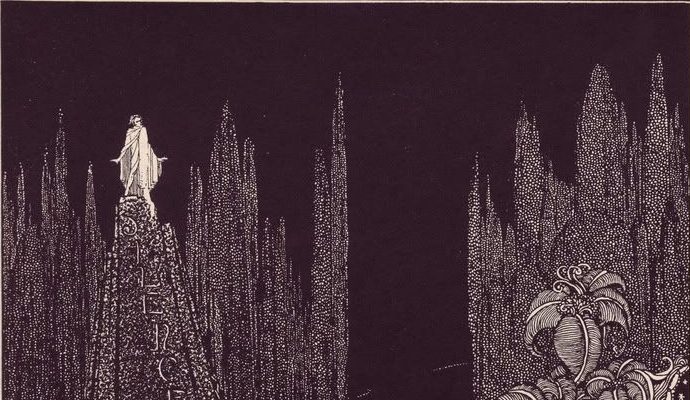
Algernon’s stories are also very anti-consumerist and critique the capitalist system from an interesting, non-materialist angle. Truly fascinating and with a forceful resonance rooted in gripping prose and unnerving, cosmic imagery. Algernon is a new favorite for me, that is for sure! Michael Kellenmeyer’s illustrated edition features gorgeous Doré-esque, B&W, engraving-style illustrations which are hauntingly beautiful and achieve the rare feat of actually complementing and elevating Algernon’s stories. I rarely like “illustrated editions” of things, and especially of something as profoundly un-depictable as “cosmic horror.” but Kellenmeyer’s unobtrusive, dark, engraving-like illustrations are an exception to this. He has conjured about 1-2 images per tale, so they do not hamper your progress or cleave your attention too much; it’s just right. Kellenmeyer has also included footnotes, which are handy, giving historical details for various nineteenth century terms, information on places mentioned, explanations of obscure terms etc. Although I have to say, at times I did chuckle a bit at some of the footnotes, which seemed a little redundant, but again, this is footnoted for the average American high-schooler I suppose. Kellermeyer also features short, 1-page analyses of each story at the start and end, which were sometimes quite interesting. Thanks Michael (also for letting me use your images on my blog, much appreciated)!
I’ve now started upon the gargantuan task of ranking all the horror stories (cosmic horror and weird fiction; not repulsive, but unsettling/unnerving tales) I’ve ever read! So far, I’ve completed the entire life’s works of Poe, James, Algernon, Lovecraft, Klein and Ligotti, and I’m close to finishing Barron’s and Slatsky’s too, and after this I will move on to Bierce I think – I’ve already ordered Kellenmeyer’s illustrated edition. His editions of James and Algernon are my top-tier recommendations for anyone out there in the abyss. Anyway, in my quest to properly read-all-that-is-out-there in this enchanting subsection of short-form horror, I am currently working through Barron’s Occultation and Other Stories. So far, so good! Just like with Ligotti, I have no idea how Barron conjures some of these stories, they’re just… mind-bending. Truly a genius! Goddamn do I feel lucky to be alive if nothing else for the simple pleasure of appreciating the distilled mastery of these fine tales and their cascading, electrifying imagery and implications. One could hope to someday add something to this mountain of horrifying beauty, but I’m afraid its futile, for these top dogs of the genre surely have some sort of dark bug rummaging in their brains, re-arranging their gray matter into something communicating with the beyond – it’s simply impossible to come up with this stuff otherwise!
March 23, 2026:
Alright, I’ve been on a short-form horror bender these past few days. I’ve finished Barron’s Occultation and Other Stories and I was blown away by several: Catch Hell – are you kidding me! What an amazing gothic/occult horror piece, such a mouthwatering, meticulous construction, combining Klein’s story-telling approach with themes from Poe’s Morella (loveless marriage, identity continuum). And what of The Broadsword? I mean are you f*cking kidding me?! Exquisite and utterly terrifying, scared the living daylights out of me. After having read over 300 horror stories from the top dogs of the genre, I think The Broadsword is the one that has most frightened me. Truly heinous! I think it’s the best entry point to observe Barron’s malignant Old Leech mythos. Unlike Ligotti’s world where the cosmos is utterly indifferent to the cancer that is humanity, in Barron’s mythos (often called the Old Leech mythos) the cosmos is raw and hungry and actively targeting humanity in the most chilling ways possible! Both have their merits. While I overall prefer Ligotti’s blend of philosophical/nihilistic cosmic gloom, I do enjoy the pure animalistic cosmic terror unleashed in some of Barron’s best tales (e.g., think of Nemesis or Shiva, Open Your Eye, or of course The Broadsword). It is fascinating to read through Barron’s stories and find the threads and oblique connections that link them all together – the man really is a genius and is slowly creating a living and vastly more malignant alternative to Lovecraft’s good old Cthulhu mythos. I really believe that Barron’s Old Leech mythos is going to be a major media item in the future, when the clods sniff it out and some major productions start adapting it (likely after Barron dies, as is the way of these things). Sadly, for Ligotti the same thing cannot be said. His beautifully destructive vision of the world, including his stories, would be absolutely impossible and entirely meaningless to adapt to any visual media, they just won’t bend that way. Barron though, once he is truly discovered and reaches the heights he deserves (remember for Lovecraft this was 40 years after he died), I think media execs are going to be salivating to grab the property rights for adaptations.
Anyway, after blasting my way through Barron’s Occultation, I immediately jumped to Brian Hodge and Christopher Slatsky (whose work I had begun several years earlier but was then sidetracked). Hodge’s On These Blackened Shores of Time is really good. I managed to pirate it, since it’s nigh impossible to acquire otherwise. I have communicated with him via his website (he is surprisingly responsive). Apparently, he’s having major supply problems but he sent me a PDF of his Skidding into Oblivion. And I also, committed to one of only 4 hardcover prints of Black Hole Sundown left in his hands (since he’s going through publisher problems it’s not being printed). I could not resist an inscribed copy from the man himself so have agreed to pay the hefty shipping cost.
In the meantime, I’ve turned to Slatsky’s Immeasurable Corpse of Nature, and I have been pleasantly stunned. While the first six tales did not really awe me that much, things really picked up from there on. “Professor Cognoscente’s Caliginous Charms Carnival” has a stunning ending of pure cosmic horror, reminiscent of Ligotti and with some really haunting imagery. And “The Anthroparian Integration Technique” is also pretty good, dark but very good. But I think the real masterpiece in this collection is “The Figurine.” I mean, wow… a truly pitch-black abyss with so many hidden details. A truly excellent grief-horror story. “From a People of Strange Language” is also really good, one of the best stories in this collection; it’s a story of primordial cosmic horror imagined and evoked in a very clever way. And the titular story, “The Immeasurable Corpse of Nature,” is an excellent example of dark cosmic nihilism, rivalling some of the best stuff Ligotti has produced especially in its anti-human tone. Truly depressing and soul dismantling, an absolute whirlwind to read. I highly recommend this collection to any fans of cosmic horror, and/or of pessimistic philosophy. Slatsky, you’ve earned my admiration and deepest respect, now I must procure your other story collection! Anyway, Ambrose Bierce and Ramsay Campbell also await. A lot to get through; I’m literally excited (pun intended).
March 28, 2026:
No house, no stability, no fixed place of residence, no country to ‘settle down in’, no job prospects, no financial future, no pension plan, no permanence in anything… only impermanence, and a soul crushing transience weighing down on every aspect of my life. God only knows where things go from here, I’d be interested to see what the f*ck I’m doing in say five years from now. Maybe mercifully dead in a gutter or a ditch or some other moist place where transient noughts like myself can peacefully decompose into non-existence. I used to be so excited about my research and the prospect of teaching and just being in a university in general. But the xenophobic, defunded clusterfuck of European humanities has flayed all the veneer off that dream, leaving nothing but a dried husk. In some twisted, pathetic way, small remnants of excitement still sometimes twitch around in that shrivelled husk, longing for a position of some permanence in this bleak, defunded edifice: “Maybe I can claw my way through these thick walls if I stoop low enough, for there surely has to be a structural weakness somewhere deep down at its foundation, somewhere where no dignity can shine.” Perhaps one day I’ll indeed find a little underground rat-hole and crawl through it. But will it even be worth it at that point? What will I even be entering? A university or a goddamn sanitarium? The future seems bleak upon bleak, and not just for me, but for all of mankind.
On that note, today I read a rather interesting article titled: “There’s a specific kind of tiredness that belongs to people who spent their entire twenties building a life they thought they wanted, only to reach their thirties and realize they were building someone else’s blueprint from memory.” While it resonated with me in some aspects what I found more jarring is that according to this article I am not even at the stage of life’s 30s despite being 35. Slightly jarring, somewhat disheartening, but also, interestingly quite liberating since the entire premise of the article is to discuss the depressive anhedonia that accompanies those who did attain the traditional goals one seeks by their mid 30s. By some cosmic twist of the thumbscrew, have I somehow avoided a form of existential anguish simply by not even existing fully according to the imagined life trajectory of the Western world. By not yet having a stable house, stable job, stable anything – which is the article’s starting point for the ‘30’s crisis’ – I am located outside of the bounds of the article’s proposed ‘tiredness’. A silver lining in my current predicament I suppose. Still, it doesn’t excuse the fact that this article seems to encapsulate a rather privileged and born-into-wealth sort of social stratum, which is not a problem, but at least put that in the title so others like myself are not gazing at the article as if reading about aliens.
Today I re-read some of my favorite Ligotti stories as a form of soothing reflection. While other excellent horror authors definitely frighten, invigorate, and rile me up in various ways (e.g., Barron, Klein, Langan, Hodge, Campbell, Slatsky), I’ve found that there are only two authors in the entire world that I have so far encountered which have the power to soothe me while at the same time beaming a radiation of cosmic horror right into my mind: Lovecraft and Ligotti. Whenever I read a story by either of these two, I instantly settle into a cozy and warm mindset, which is supremely ironic given their subject matter. I think it might be because none of their stories are actually frightening in the traditional sense but are instead more akin to philosophical probes into the insignificance of the human condition. And they relay this with such beautiful, dreamy sentences and narratives that it is easy to just get lost in the artistic beauty of both their prose and the cosmically-terrifying ideas being relayed. Today I re-read The Troubles of Dr. Thoss and Dr. Voke and Mr. Veech, the latter of which is one of my all-time favorites. I think it is the highlight of the Songs collection at the very least; such a masterful construction, such a haunting ending… sublime indeed.
I spent an hour or so a few nights ago thinking of and writing this single-paragraph cosmic horror story (I might try to expand it one day; I think it has a good conceptual core, although perhaps a bit too Barron-esque):
If you ignore all the distractions and other microscopic concerns that occupy your mind, and push aside, momentarily, all the mental cobwebs and other padding that dampens her ability to look in on you, you might see her raw and uninhibited gaze, eternally craning her elongated neck to stare at you. She watches you from the lightless patches of the sky. She’s always been watching you, patiently waiting to meet you, crawling across the darkness between the stars, her lips gleaming black. Once you finally meet her stare and look deep into her lidless aperture, you will see countless human faces gazing back at you, frozen many light years away, their eyes frosted over, mouths dilated wide. But they are long gone now. They too had looked up and met her gaze, long before you were born. It’s too late now for you too. She smothers the sun as she descends, as she does every evening, looking for those like you. You might feel a light breeze, if anything at all, before she swoops down and rides you into the galactic forest. You will get one final look back down at the receding pinpoint that was your entire world before she pins you beyond the event horizon.
April 5, 2026:
[Review of Brian Hodge, Skidding into Oblivion]: After emailing Brian and receiving a copy of Skidding into Oblivion, I ended up traveling to the Swiss Alps where I read it through in Selin’s (and therefore also my) new house with mystifying views across Lake Geneva. One of the standout stories of this collection for me was “One Possible Shape of Things to Come.” It’s based on the simple premise of a small child waking up at night and starting to stand in the corner of his bedroom, facing the corner, night after night… Brian takes this kernel of an idea and transforms it into a brilliant extinction event wrapped in pure cosmic horror. Another memorable and really solid story was “Just Outside Our Windows” which I really cannot say much about without spoiling, so I won’t, but it is quite Ligottian in its absurd and nightmarish originality. A third story that really stood out for me in this collection was “The Same Deep Waters as You.” It should seriously be the canon sequel for Lovecraft’s Innsmouth. It’s a complete, longue durée re-framing of the original story, not merely a bland pastiche, and it does this in the best possible way. And the ending is really good, chilling… These three were my top picks from this collection but I did also quite like “Eternal, Ever Since Wednesday” if for nothing else for its ‘snow, snow, and more snow’ setting. I mean, who wouldn’t enjoy an eerie family drama rooted in a snow-apocalypse? Several other stories that were alright (and in fact pretty great in some places), but did not captivate me as much as the above were “This Stagnant Breath of Change” which is a small-town Lovecraftian tale involving the Black Goat with a Thousand Young, and “Scars in Progress” about a form of demonic and primordial horror haunting the world. I found the premise and set-up of “Scars in Progress” to be really good, what with its image/photograph usage and the primordial connections, but sadly the ending just fell slightly flat. I find that action-packed endings tend to in this genre. The ending sort of de-mystified the tale and took me out of the cosmic mindset and stripped away the enormity of the situation. “Roots and All” was also similar, with a captivating and haunting lead-up to a somewhat unsatisfying and predictable ending. Still, even the stories that I didn’t enjoy as much were still decent. This is mainly thanks to Brian’s prose flowing really well; his sentences always seem to be just the right length and in the perfect places, making every story in this book really ‘readable’. There’s no deeply purple prose or Ligottian abstractness, but a beautiful, purposeful simplicity and elegance running throughout the entire collection. Many times did I stop reading and just admire how well certain sentences or phrases fit into the story, or how well the imagery was evoked. This is the first full collection of Brian’s that I’ve read and I’ve grown to really like his writing style, despite it being different from Ligotti or Barron, both of whom I also really like. I also really enjoyed reading Brian’s comments at the end of the book on how he came up with each individual story, such a nice idea to include a section like this. Overall, I would highly recommend this collection to any short-form or cosmic horror fan, and in particular the three stories I listed as my favorites are up there with the best of the genre. Due to publisher issues the book was unfortunately pulled and is currently on a printing hiatus, but it is possible to obtain an electronic copy by simply contacting Brian on his website: https://www.brianhodge.net/contact.
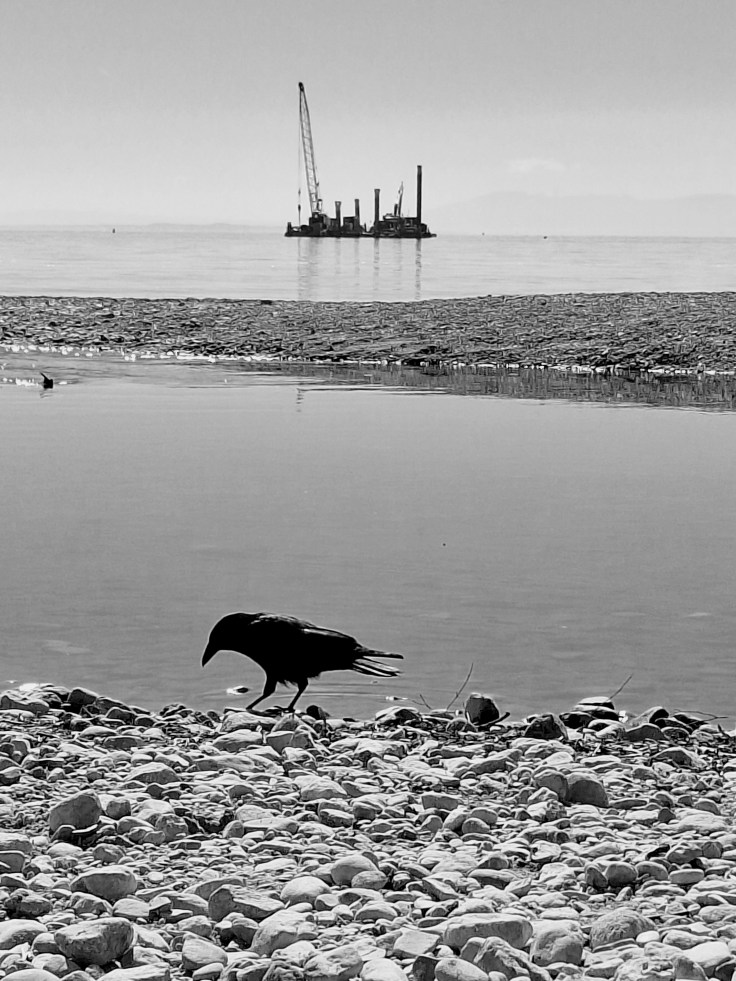
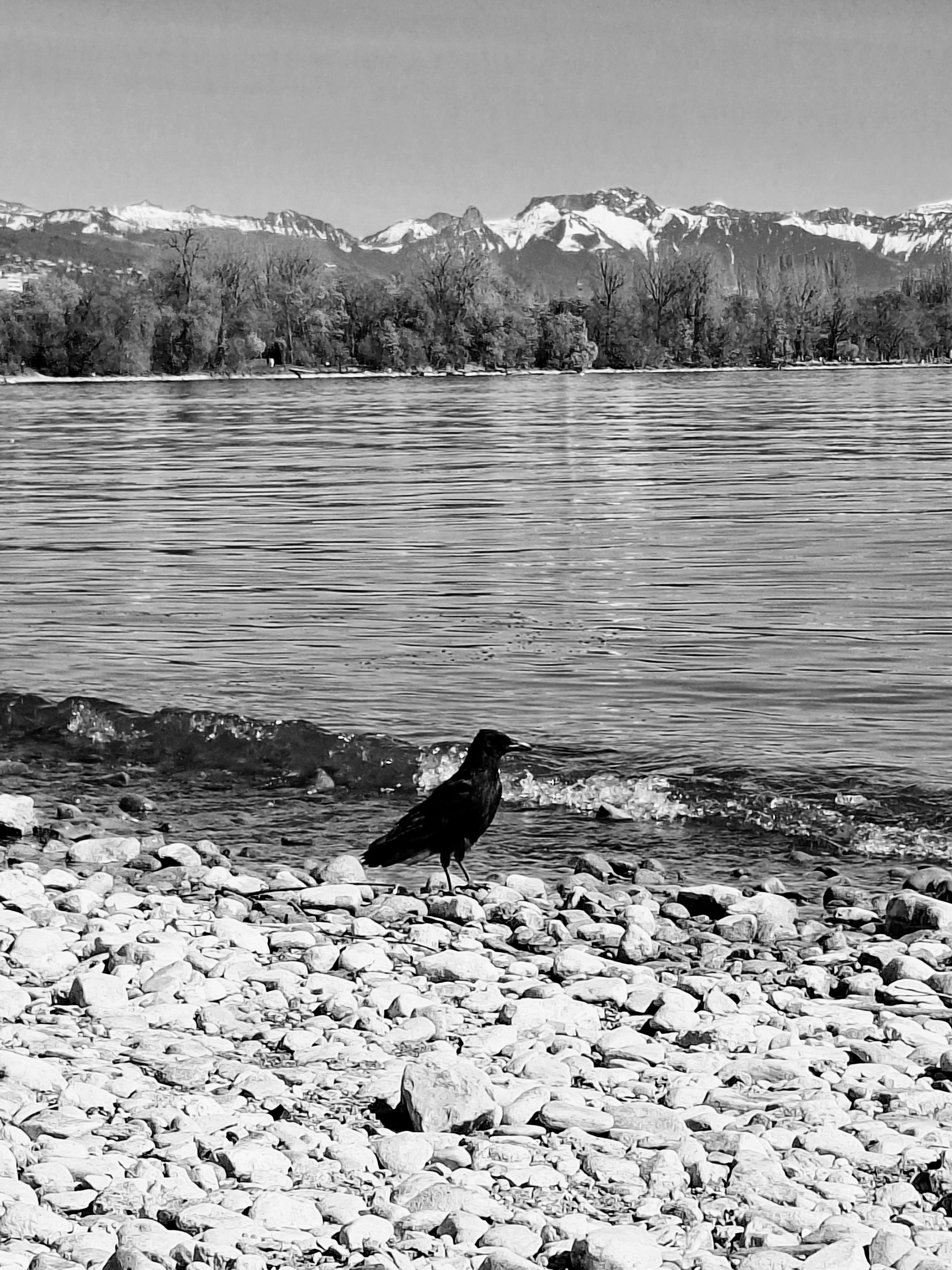
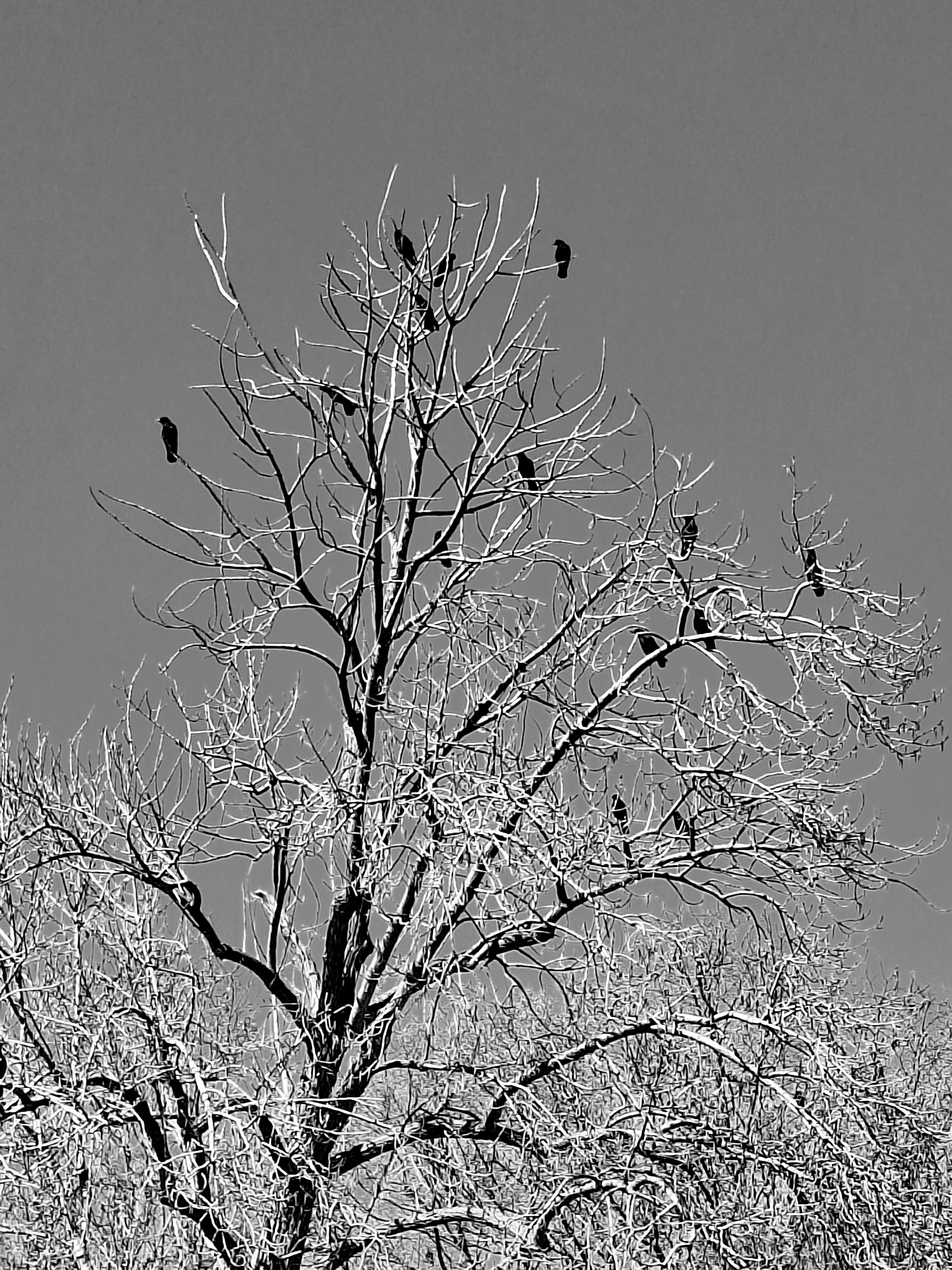
It was just me and the ravens on the lake-front as I read through this collection, quite atmospheric:
***
April 12, 2026:
It’s rainy in Lausanne, stormy in fact. The mountains rumble, the lake churns, the sky roils with the power of nature. Beautiful. I put on Pawel Perepelica’s Absolution, that hauntingly cosmic soundtrack, and just gaze out the window. It’s almost like space itself contracts and folds towards me, revealing galaxies, clusters, and astrogenesis filaments hitherto unseen by mankind, reminding me that this sewage producing planet is the smallest type of nothingness in a vast and eternal vacuum that surrounds us on all sides like a black blanket… such is the power of this music. What a trip indeed.
And then, with a chill running down my spine, I recall that this fascinating lacuna in our knowledge doesn’t just concern things up there, but also things down here, in the ocean, in the black waters of the deep sea. I mean, just stop for a second and contemplate the abyssal zone, really think about it, about that bottomless (lit. ἄβυσσος) region of the ocean beyond 4000m depth that remains in perpetual darkness, spanning thousands of kilometers of Earth’s surface, hiding god knows what in its ink-black, hauntingly still waters… There is literally no light; that is the definition of the abyssal zone. And beyond that is the hadal zone, forming even deeper trenches along the abyssal zone’s bottom surface; the true ocean-floor. I shiver even thinking about the strange biologics that squirm and slither in those pressurized pits. It’s not like mankind’s even explored them properly. We really have no idea what they are up to down there… It is completely maddening. We only know of a few species that we happened to glimpse when they washed up somewhere or when a deep-sea exploration pod happened to beam its headlights onto them, such as the other-worldly tripod fish (Bathypterois grallator) or the abyssal grenadier or various strange snailfish types. Encountering these things is truly ego-dampening in its implications; the environment they live in is so hostile its sort of comparable to the vacuum of space. They are superior to us.
Speaking of the great beyond, I was excited to read through David Kipping’s 2025 article titled “The Eschatian Hypothesis” on the subject of SETI. It seems so obvious when he states it, I cannot believe this idea has not been a staple of the field already. Here’s a section from the abstract: “The history of astronomical discovery shows that many of the most detectable phenomena, especially detection firsts, are not typical members of their broader class, but rather rare, extreme cases with disproportionately large observational signatures. Motivated by this, we propose the Eschatian Hypothesis: that the first confirmed detection of an extraterrestrial technological civilization is most likely to be an atypical example, one that is unusually “loud” (i.e., producing an anomalously strong technosignature), and plausibly in a transitory, unstable, or even terminal phase.” The article begins with a historical sweep of astronomical ‘first discoveries’ of things like exoplanets, which were always atypical and often magnified examples of what is more typical in the universe. The basic logic goes, why would our first discovery of extra-terrestrial intelligence be any different in pattern? Let’s hope that we find something soon, because the great black void is grinning down at us ever wider as of late. It would be nice to know of something else out there.
April 18, 2026:
I was conducting my daily sanity walk along Meent in Rotterdam, idly observing strange light textures flicker beneath the eaves of low hanging roofs and appreciating sunlight glitter through the hair and loose garments of passersby, when I began thinking about atmosphere in a much less idle manner. This thought process galvanized my spirit so much that I felt inclined to stop at Cafecito for a coffee, because why the hell not, despite the sunny-Saturday queue spilling out onto the street. I pursued this avenue of thought all through the queue and for a large part of the rest of my walk before moving onto other ephemera and stubborn anxieties. Now at home, I’ve decided to honor my elated, sun-struck, few-hours-ago self and write down what I was thinking about.
I first encountered atmosphere when I was born and looked up at the sky, and saw the sun and the stars and the trees and all that green, blue, and black stuff, or when I first heard the rain, or in other words, when I first observed nature in operation. This included all of my senses; seeing nature, hearing nature, smelling nature, tasting nature, and feeling nature touch me. The exhilaration of atmosphere somewhat faded as I got used to seeing some of this stuff; my heart does not skip a beat each time I regard a tree or look at the night sky. Although, sometimes, certain conditions of nature, imbued with certain particular and hard-to-define sensory cues and mood vectors, can still occlude my brain and overwhelmingly fixate my attention on the simple concept of aliveness and sentience. This need not always be associate with nature, and thankfully it is not, for otherwise the continuous and relentless ecocide all around us would indeed be more distressing than it already is. Certain urban vistas or even reflections of grime and decadence can elicit this response too.
This is undoubtedly a pleasant mind-state of solitude and quiet reflection and therefore something to be desired and sought out. But boxed into our tiny homes, living monotonic lives that worm along linear patterns defined by endless repetition and mundanity, we hardly find much room for this. One solution to this problem is to be found in media. Media is currently, as of the early twenty-first century, able to reliably stimulate two of the five senses (seeing and hearing), while the other three senses cannot currently be sent across fiber-optic cables or paper pages. But even if just confined to two out of five senses, exploiting this sensory pipeline still allows us enter the above-mentioned atmospheric mood-state while trapped between four walls.
My first encounter with this form of what I will call simulated atmosphere occurred via various forms of childhood media. These ranged from certain highly atmospheric video games where I just walked around doing nothing in particular but immersing myself (e.g., VtMB) to atmospheric literature where I hardly even remember the story but the mood will never leave me (e.g. Cyberpunk; William Gibson’s Neuromancer) to atmospheric shows and films where I hardly followed or cared for the plot but instead devoured them on repeat for the atmosphere (e.g., The Killing, Twin Peaks, The Dark Knight, The Thing) – experiences often elevated considerably by the soundtrack or color palette or some other illusive aspect that was perhaps not always intentional for the directors.
More recently, I have been encountering this same blend of simulated atmosphere in video games such as Rogue Trader, Cyberpunk 2077, Stasis, Pentiment, Disco Elysium, etc. and in films such as The Neon Demon, Tangerine, and almost all of Nuri Bilge Ceylan’s films and some of Nicholas Refn, David Lynch, Werner Herzog, Alex Garland and Sean Baker’s stuff, to name a few. The common point of these things is that I hardly care for the plot or story or whatever (not to say that they have bad plots, but it’s not the main focus for me), but I instead cherish how they transport me elsewhere solely through simulating an atmosphere. For some elusive reason some directors just do not interact with my atmospheric input center, some such as Gaspar Noe and Yorgos Lanthimos somewhat surprisingly so.
Certain music also does this. But eclipsing all of that has been something else, something capable of conjuring a simulated atmosphere and then really keeping it there, hovering behind my eyes for a long while. That is weird fiction. Since I first properly discovered it about a decade ago, this sub-genre of literature has been suspending me into places I could not otherwise dream of treading. It felt like discovering a gold vein right in my moldy bedroom, and I’ve been mining it ever since. Cosmic horror in particular (HPL, Ligotti, Baron, Hodge etc.) but also gothic surrealism (Poe), grief spiraling (best done by Slatsky), and all sorts of other sub-genres banded under the umbrella ‘weird fiction’ have been truly captivating as of late.
The specific thought-germ that first brought all this to my attention was the nagging atmospheric void created by my craving for more sci-fi atmosphere. Since watching The Expanse many years ago, the next best thing has been Owlcat’s tremendous writing in Rogue Trader, combined with its accompanying dark orchestral music, and the bleakness and intricacies of a deep-space void-ship surrounded by the hostilities of the warp. Particularly the character of Cassia and how she defines everything in terms of colors and hues and the enchanting imager she uses struck a chord within me. This was the specific thing I was contemplating while walking along Meent earlier today in response to the reflection: Why do I like Rogue Trader more than Baldur’s Gate III? And I was also considering Thomas Ligotti’s explanation of how of two horror stories of possession, The Case of Charles Dexter Ward by Lovecraft captivated him, but The Exorcist by William Blatty bored him. It’s a similar sort of idea: one of them properly encapsulates and delivers on atmosphere and the other does not to the same degree.
Anyway, I have no idea why I even decided to try to clarify and define something so evasive and vague and highly subjective. It was a fun excursion nonetheless. Time to stop now and continue writing my “Byzantine monetary failure thresholds” article and resume boxing up the entire house in preparation for the moving truck next week… Atmosphere save me…!
 Mete's Personal Blog
Leave a comment