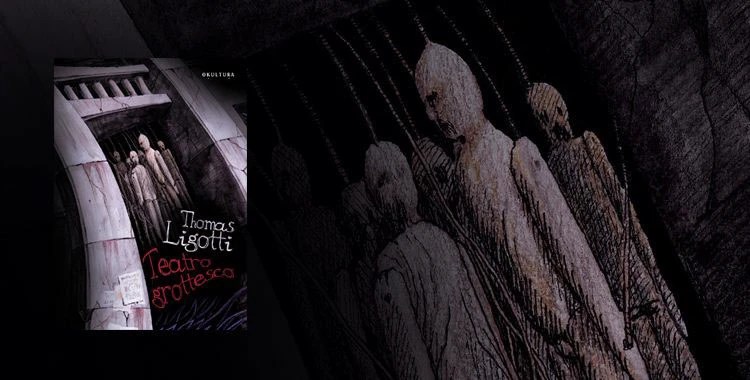
I initially read Ligotti’s works in order of their publication, thereby observing his evolution as an author (but have since re-read all of his stories multiple times, such is their allure). After reading his earlier three collections, Songs of a Dead Dreamer, Grimscribe, and Noctuary, I couldn’t fathom how it could get any better, but it somehow does. He’s refined his craft to truly maddening heights in Teatro Grottesco.
While most often posited as the continuator of a literary legacy extending back to Poe, Blackwood, Machen, and Lovecraft, anyone who has read his works will quickly realize that Ligotti is a genre in himself. And in fact, his name is now utilized in adjective format (Ligottian) and pinned next to other aspiring authors as a sort of badge of honor, even though I have seen no one capable of replicating the dreamy, whirling darkness that he so masterfully conjures. Other incredible authors of what is often called ‘weird literature’ or ‘cosmic horror’ deal with different themes such as human grief (Slatsky, Hodge, Burnett), the malignant supernatural (Barron, Langan, Evenson), or just write straight up scary stories in the vein of M.R. James or Ramsey Campbell. Ligotti, on the other hand, writes stories that are so intelligently crafted, so hauntingly beautiful, and which always feature some form of societal or existential critique, leaking out elements of his nihilistic and later on pessimistic worldview. As such, Ligotti’s stories are not scary in the sense of “made me scared to sleep,” but are horrifying in the sense of what they suggest about life and existence and the universe. BUT…
But there is a catch; a paradox. The paradox of Ligotti’s writing is that it is absolutely beautiful, which is ironic given how steeped in absolute pessimism and bleakness his themes are. The real paradox, though, is that somehow Ligotti’s writing is cozy and spiritually uplifting. Interestingly, his ability to channel his mental darkness into a form of art so profoundly beautiful helps show that this is an option, that channelling negative energy away – away and into art – is an option in this life. Clearly, this is how Ligotti has ‘coped’ (for lack of a better word) with some of the things he articulates through horror stories. This is comforting. It shows how one can express one’s inner turmoil with the most hauntingly enchanting imagery in the most gripping and thought-provoking narratives and thereby perhaps be relieved of some that burden, or at least find purpose in one’s “useless” life – to echo some Ligottian sentiments. It is spiritually uplifting because it can be used to illustrate how this same avenue may be available for other lost souls wandering the darkness along the outer rim of modern life. Reading Ligotti is therefore soothing, existentially and otherwise. This, then, is the beautiful paradox of Ligottian fiction (not of his non-fiction though, but that’s a discussion for later).
In Teatro Grottesco, Ligotti produces a writing style distinct from his earlier works: less flowery but somehow no less enchanting, leaning quite heavily into repetition, unusual phrasing, and humor as literary tools (a trend I first noticed in his earlier work, My Work is Not Yet Done). Thematically, Teatro Grottesco can be very broadly divided into two: (1) the ‘work horror’ pieces that offer societal mirrors and which hit hard as beautifully articulated existential critiques, such as “Town Manager,” “Our Temporary Supervisor,” and “My Case for Retributive Action.” And (2) the rest, which all function, to varying degrees, as narrative conduits relaying Ligotti’s bleak worldview. And I specifically use the word ‘bleak’ here instead of ‘dark’ because this is a noticeable shift in the undertone of this collection compared to Ligotti’s earlier stuff. In his earlier works such as “Dr. Voke and Mr. Veech,” “Dr. Locrian’s Asylum,” or “The Mystics of Muelenburg,” the universe is dark, almost brilliantly, fascinatingly dark, and we crescendo together with his protagonists into a dazzling void. The stories most similar to these is in this collection are “The Clown Puppet” and “Gas Station Carnivals,” whereas in many others here, such as the three abovementioned ‘work horror’ tales in addition to “In a Foreign Town, In a Foreign Land” and “Sideshow, and Other Stories” we get these stories without a ‘dark crescendo’ in Ligotti’s earlier style, but which instead fizzle out in utter bleakness upon endless bleakness (still with his same worldview; it’s only the articulation that has changed). This is no less powerful and I enjoyed it just as much, but it is something noticeably different in Ligotti’s 50-year-old style that we see here (compared to his 30-year-old style in Songs, for instance).
Just like in his Grimscribe collection, there are stories here that are almost completely (i.e., even more than the rest) philosophical overtures, for which particularly “The Shadow, The Darkness” but also “Severini” come to mind. Additionally, a relatively new thematic angle for Ligotti that emerges quite powerfully in this volume is that of art horror merged into identity horror. Particularly “Teatro Grottesco,” “Gas Station Carnivals,” and “The Bungalow House” play around with this theme in really chilling ways. And as I said, each and every story here contains a sense of humor (to varying degrees); that uniquely Ligottian jet-black humor that I have come to really enjoy. I’ll now go over the stories in order.
The collection opens with the story “Purity” which is a fascinating concept, that of obsession, taken to obscene heights (cf. Lovecraft’s Herbert West). Not bad, but for me the real highlights of the volume were just around the corner. “The Town Manager” hits like freight train. It instantly draws you in with its beautiful prose – now less purple and more simple; more directly mesmerizing. Here Ligotti conjures an electrifying, eerie mirror of the world so masterfully well, only to then rend it away, layer by layer, until we reach an archetypical Ligottian finale. A beautifully articulated, poignant societal critique and an incredible feat of existential horror. Even if you read nothing else, read this story.
Immediately following this we have “Sideshow, and Other Stories” which is a collection of five existential horror vignettes that are loosely nested in an identity horror meta-narrative. It is really well written, really electrifyingly so, and I absolutely loved how Ligotti’s grim worldview is presented in the vignette titled “The Malignant Matrix.” Even if you don’t agree with his philosophy, you will appreciate how he articulates and envisions things. Its complexity might not be for everyone’s tastes at it sort of demands some forehead-wrinkling neural activity as one’s eyes glaze over the words, and I had to read it twice to even begin to understand it. So, not really a “relaxing Sunday read,” but more a “deconstruction effort.”
Then we have the second highlight of this volume and a real masterpiece of philosophical/existential horror: “The Clown Puppet.” This story is just so well-constructed and written, it draws you right in with its mesmerizing black humor and witty existential critique peeking out from behind its glamorous, uncanny façade. The repetition of the “nonsense” stuff works so well. And the whole meat shop angle combined with the odd inclusion of “goat” is just the icing on top. And what about that ending…!? There’s just nothing bad about this story; not a single misplaced word or overcrowded paragraph. This story together with “The Town Manager” is proof enough of Ligotti’s genius. Perhaps due to some odd condition of his psyche, he seems to be able to produce these stories that literally no one else could possibly even begin to fathom; rainbows vomited up by some deranged whirlpool churning around in his decaying gray matter. “The Clown Puppet” checks absolutely every box there is.
Then there is the highly experimental story, “The Red Tower.” It has no character and almost no plot either, consisting entirely of a structural description, which gradually and insidiously reveals things about the world. This piece is ingenious in its construction, although likely not for everyone, since it can be a bit dull if not paying attention to the societal/existential critiques buried beneath its flowery visage. Not my favorite story here, but definitely one that I respect in a literary sense.
Next, we have two exquisite tales of what I’m going to call ‘work horror’ (or alternatively ‘industrial horror’ or ‘corporate horror’). The first, “My Case for Retributive Action,” is a stunning societal critique that both contains lots of black humor (not the least delivered through Ligotti’s brilliant use of repetitions) and bone-chilling horror that really crescendos toward the end. It revolves around a new employee in a ‘form processing company’ with an endless workload which spirals into further monstrous endlessness upon eternal endlessness… How Ligotti narrates this bleakness is just pure brilliance (ironically).
Then comes “Our Temporary Supervisor,” the third real highlight of the volume, which is somehow even better than “My Case for Retributive Action” (works well to read these two in sequence), really upping the ante of gloom and existential bleakness rooted in the modern workplace. Details like the company not accepting resignations and then eventually extending this policy to not accepting retirements, the whole ‘unseen supervisor presence’, and the gradually building hopelessness and self-imposed efficiency is just so masterfully presented its almost maddeningly good! Ligotti proves, once again, that he is the undisputed master of this sub-genre of horror fiction that I’ve here called ‘work horror’ but which is alternatively sometimes called industrial or corporate horror.
Next comes “In a Foreign Town, In a Foreign Land,” grouped together in the volume with the previous two tales. This time we are treated to four sub-stories that merge into a creepy and iconically Ligottian ‘reality horror’ saga. The idea of un-creation in the first is chilling, the creepy motel and jingle-jangling housekeeper thing in the second is very unsettling, and the unfiltered existential bleakness of the third is… hauntingly beautiful. Small details like how the second vignette opens with the bench scene makes our journey all the more enchanting. This quartet of nested stories probably won’t chime with everyone, but for those who appreciate Ligotti’s philosophical musings it really hits hard. “In a Foreign Town, In a Foreign Land” is up there with his best existential explorations of the human condition – despite the story’s janky name (come on Tom, surely you could’ve come up with a slightly less awkward name for this one).
Then we have the titular story, “Teatro Grottesco,” which shifts the collection’s gears to a more personal level for Ligotti, it would seem, exploring ‘the end of artistic drive’ and the dissolution of creativity while critiquing art more broadly. It does this via the extended ‘metaphor’ of a grotesque theatre troupe that haunts artistic individuals. While still quite interesting, I think it’s my least favorite in the collection thus far (simply because everything before it was so damn good).
The next story, “Gas Station Carnivals,” follows in the same vein of art and identity horror, but begins with what is likely the coziest opening paragraph Ligotti has ever written. I enjoyed this story much more than “Teatro Grottesco.” First of all, it has some seriously haunting imagery in the ‘The Showman’ and the dilapidated carnivals with their creepy sideshows all presented through the fog of memory. These conjure a more traditionally eerie backdrop upon which Ligotti then does Ligotti things, unpacking identity and reality before delivering a crushing and iconically pessimistic finale. Additionally, I think the diner/pub setting works much better as a narrative stage than the non-descript venues that rotate in and out of “Teatro Grottesco.”
Then we have “The Bungalow House,” where the story is narrated by a person undergoing a complete psychological unraveling. This story is more tangible than the previous two (which were primarily mood/theme stories) and has more of a plot. The premise is simple: A man keeps visiting an art gallery on his lunch breaks to listen to a mysterious series of audio tapes. Eventually the story becomes one of obsession and identity horror, as we slowly descend – alongside the protagonist – into the abyss of the human condition.
After this comes “Severini,” where we embark on a dreamy and mood-driven descent into madness, which, as Ligotti is eager to always hammer home, is actually not madness but what ought to be our natural state, since it is the logical opposite of the true madness that is the mass delusion whereby human existence is seen as worth anything above absolute zero. This is a profoundly anti-life and anti-natalist story (even more so than the preceding stories) which therefore only classifies as ‘horror’ for those who disagree with Ligotti, which will be almost everyone reading it. That being said, even without subscribing to Ligotti’s philosophical pessimism, it is still generally enjoyable as a reflective mood piece: It has intense imagery and functions well as a ‘deranged narrator’ story (this works on both levels: Severini as the deranged story narrator or Ligotti as the deranged meta-narrator!).
The collection then draws to a close with the aptly named “The Shadow, The Darkness.” This story functions as a deeply personal philosophical overture for Ligotti and a continuation of “Severini” in many ways. The first two sentences are immediately just pure Ligottian brilliance, what with that one-word in italics and the phrase “nucleus of nowhere.” Just these first two sentences (1) stir our curiosity, (2) generate a small mental chuckle (Ligotti’s signature phrasing-humor), and (3) set the tone of what is to come. This is what I mean when I keep underlining “Ligotti’s genius.” Anyway, the story then progresses into a beautiful, humorously-written philosophical ‘horror’ tale about the shadowy blackness that lurks behind the façade of everything within and to do with human existence. Again, we find references to gastro-intestinal troubles in this story, just like several prior stories, showing how much Ligotti’s real-life bout of such troubles must have affected him. This final story also seems additionally personal for Ligotti since he keeps ‘self-referencing’ a fictional version of his non-fiction novel (The Conspiracy), and also alluding to his earlier fictional works, such as “The Tsalal.”
In closing, I would like to underline that this collection contains some of the best horror stories ever written. Go and read it if you haven’t already. But read it properly; think about it, consider the closing paragraphs (often where the density of brilliance increases), then re-read it, then think about it again, and then, finally, maybe you can bloom, rose of madness, bloom in the gloom that looms beyond the moon.
 Mete's Personal Blog
Leave a comment